
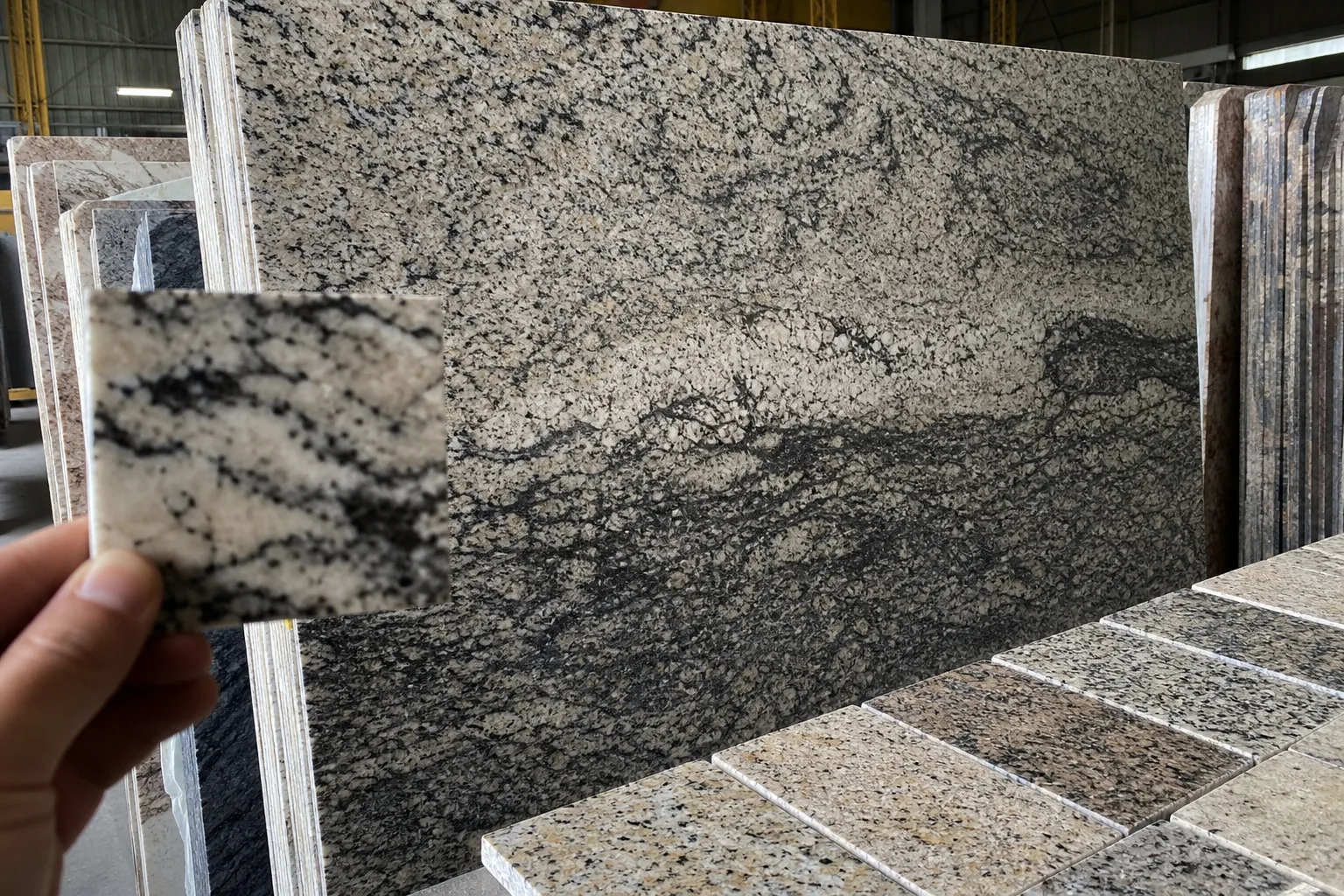
A small granite sample cannot represent every part of a full slab or production batch. It may show the general color family, grain scale and specified finish at one location, but it cannot reveal the frequency or distribution of veining, mineral clusters, tonal zones, inclusions, fissures or other natural features across several square metres of stone. For commercial purchasing, the practical answer to granite sample vs full slab is therefore not to choose one or the other: use a traceable physical sample to establish a reference, then approve the actual slabs or a documented range from the material allocated to the order.
What a Small Sample Can and Cannot Confirm
Granite dimension stone is produced from natural rock quarried into blocks and processed into slabs or cut units. The U.S. Geological Survey identifies color, grain texture, pattern and surface finish as normal dimension-stone requirements, alongside size, shape, durability and strength. These characteristics do not all operate at the same scale. Grain texture may be visible in a hand sample, while a broad band, vein or tonal transition may extend across much of a slab. USGS dimension stone overview.
Reasonable uses for a sample
- Confirming that the proposed material is in the intended broad color and texture family.
- Reviewing the appearance and tactile character of a polished, honed, flamed, bush-hammered or other specified finish.
- Comparing the proposed stone with adjacent materials under project lighting.
- Creating a retained reference for later inspection, provided it is identified and accepted as a reference rather than a promise of exact uniformity.
- Supplying material for a defined laboratory procedure when the specimen is selected and prepared according to the applicable test method.
What it does not establish
- The full aesthetic range of the block, bundle or shipment.
- The number, position or continuity of veins, spots, bands and mineral concentrations.
- How adjacent slabs will match at seams or across repeated wall and floor modules.
- The usable yield after templates, edge exclusions, cut-outs and defect allowances are applied.
- Compliance with physical-property requirements unless appropriate sampling and testing have been completed.
A sales chip, an approval sample and a test specimen are not interchangeable. ASTM C615/C615M covers material characteristics, physical requirements and sampling relevant to granite dimension stone for building and structural purposes. A visual chip alone is not evidence that those requirements have been tested or met. ASTM specification for granite dimension stone.
Natural Variation Occurs at Several Scales
Variation should not be treated as a single issue called “color difference.” A useful review separates fine-scale mineral texture from slab-scale movement and batch-scale range.
Within a single slab
One slab may contain quiet areas and more active areas. Its appearance can change through shifts in mineral proportion, crystal size, grain orientation, banding, veining or localized concentrations. A sample cut from a quiet corner may omit the feature that dominates the centre of the slab. Conversely, a sample taken from an unusually active area may exaggerate the typical movement.
Between consecutive slabs
Slabs sawn from the same block often have a visual relationship, but they should not be assumed to be identical. Features may move, widen, narrow or disappear as cutting progresses through the block. Slab sequence can matter when bookmatching, matching an island to perimeter counters, or arranging continuous facade and floor patterns.
Between blocks or production lots
Material sold under one trade name may be produced at different times or from different quarry faces or blocks. The range may therefore change. The Natural Stone Institute notes that scientific stone descriptions focus on mineralogical composition and geographic locality, while commercial descriptions often emphasize locality and color. This distinction is important because a trade name is not, by itself, a complete geological or visual specification. Natural Stone Institute: scientific versus commercial definitions.
Record the declared stone name, supplier code, block or lot reference where available, slab numbers, dimensions, thickness and finish. Do not infer quarry origin from a familiar trade name unless the origin is supported by current documentation.
Use a Layered Approval Package
The approval package should become more representative as the project risk, order quantity and visibility increase. A single sample may be adequate for an early design discussion, but it is weak evidence for final batch acceptance.
| Approval item | What it shows | Main limitation | Recommended record |
|---|---|---|---|
| Small physical sample | Local color, grain and finish | Shows only one small area | Sample ID, date, finish and source lot |
| Range sample set | Lighter, darker, quieter and more active appearances | May still omit rare slab-scale features | Label each piece as low, typical or high range |
| Current slab photographs | Overall movement and approximate slab-to-slab range | Color depends on lighting, camera and display | Unedited files with slab IDs and dimensions |
| Bundle overview | Quantity, sequence and general consistency | Outer slabs may obscure internal slabs | Bundle number, slab count and inspection date |
| Slab video | Continuity and surface reflection under moving light | Not a dimensional or laboratory measurement | Continuous recording linked to slab IDs |
| Physical mock-up | Combined stone, finish, joint, lighting and installation effect | Represents only the approved mock-up area | Signed approval record and retained control sample |
For visually variable material, request a range rather than an idealized “best” piece. The set should deliberately show acceptable extremes. If a characteristic is unacceptable—such as a particular dark concentration, broad band or open feature—define it with photographs, location rules or measurable limits where possible. Statements such as “uniform,” “clean” or “same as sample” are open to conflicting interpretation.
Write Specifications That Can Be Inspected
A purchasing specification should separate identity, appearance, dimensions, finish, performance documentation and acceptance procedure. This reduces the risk that a visually acceptable sample is mistaken for approval of every other requirement.
Material and product description
- Commercial name and supplier material code.
- Declared quarry country or region only when documented.
- Product form: full slab, random slab, tile or cut-to-size unit.
- Nominal and permitted dimensions, including thickness.
- Face finish, edge finish and any required surface treatment.
- Intended application and service environment.
Visual acceptance criteria
- Approved reference sample or range sample identifiers.
- Acceptable range for background tone, grain scale and movement.
- Treatment of veins, mineral clusters, fissures, pits, resin-filled areas and repaired features.
- Rules for slab-to-slab matching, bookmatching or vein direction.
- Areas that must remain visually continuous after cutting.
- Lighting conditions and wet or dry condition used for comparison.
Inspection records
Require records that link observations to identifiable material. A useful slab schedule lists the slab or crate number, dimensions, finish, quantity, image filenames, disposition and reviewer. Mark each item as accepted, accepted for a restricted location, held for clarification or rejected under a stated criterion. Retain the approved record with the purchase order and later revisions.
For additional procedures, see the guides to granite quality control, color variation, granite defects and third-party inspection.
Finish, Lighting and Application Change the Comparison
The same stone can appear different after its surface is changed. A polished face emphasizes reflection, color saturation and grain contrast. A textured face scatters light and may appear lighter or less sharply patterned. Approval should therefore use the production finish whenever appearance is a contractual requirement. A polished sample should not be the sole visual reference for a bush-hammered, flamed or split-face order.
Compare under controlled conditions
- View the sample and slab in the same dry or wet condition.
- Use consistent illumination and avoid comparing one item outdoors with another under warm indoor lamps.
- Remove dust, slurry and temporary protective films before final assessment.
- Photograph a neutral reference or color target when images are being used for remote decisions.
- Do not rely on screen color as the only basis for a narrow color tolerance.
Application also determines the required review scale. A small sample may communicate enough for isolated stair treads or small landscape units when broad variation is acceptable. It is much less informative for a large kitchen countertop, continuous floor or grid of facade panels, where seams and repeated units make variation more visible. For counters and feature walls, complete slab layout and seam approval before cutting.
China Sourcing: Approve the Allocated Material, Not a Generic Sample
When sourcing granite from China, the fundamental variation issue is the same as in any other supply market: a generic showroom chip may not have been cut from the block or batch allocated to the order. Distance, time-zone differences and international logistics make traceability especially important because replacement after cutting or shipment can be slow and costly.
Before production
- Ask whether the submitted sample comes from current stock, an earlier order or a reference library.
- Obtain written confirmation of the material code, finish, thickness and intended product form.
- Define whether one block, one bundle or multiple lots may be used.
- Agree on acceptable visual range and the evidence required before cutting.
- Identify who has authority to approve changes or substitutions.
Before shipment
- Request current images linked to slab, bundle, crate or pallet identifiers.
- Reconcile approved quantities with the packing list and inspection record.
- Check whether accepted slabs have remained reserved for the order.
- Record any restricted-use slabs and their intended cutting positions.
- Preserve approval files, revision history and written concessions.
These controls do not prove a supplier's capability, quarry ownership or certification status. Such claims require separate verification. Buyers planning an international order can also consult importing granite from China, evaluating China granite suppliers, supplier audits and container loading controls.
Price Factors and a Practical Acceptance Sequence
More demanding selection can affect cost without changing the stone's quoted base rate. Relevant factors include the proportion of slabs accepted, the number of blocks needed to obtain a narrow range, extra photography or inspection, dry-laying, mock-ups, layout work, cutting yield, restricted slab use, replacement risk, storage and schedule. No universal premium should be assumed; request a quotation that identifies which approval and selection services are included.
Buyer checklist
- Define the product. Record stone code, form, dimensions, finish, application and required performance documentation.
- Review geological and trade identity separately. Treat the commercial name as an identifier, not proof of precise mineralogy or origin.
- Approve a range. Include representative low, typical and high variation rather than one preferred chip.
- Link evidence to stock. Require slab or bundle identifiers on photographs and schedules.
- Set exclusion rules. Describe unacceptable features and how they will be measured or located.
- Approve layout where continuity matters. Review seams, vein direction, cut-outs and adjacent slab relationships.
- Inspect before irreversible work. Complete the agreed review before cutting, surface treatment, packing or shipment.
- Keep records. Retain samples, images, approvals, concessions and inspection results under revision control.
The key sourcing principle is simple: approve the level of material that carries the risk. Use a sample for local appearance, a range set for acceptable variation, current slab or bundle evidence for the allocated batch, and a layout or mock-up for the final assembled effect. None of these replaces application-specific specifications, testing or professional design review.
Frequently asked questions
Can I approve a granite order from one small sample?
A small sample can establish a general color, grain and finish reference, but it should not be the only approval evidence for a visually important slab or batch order. Request representative range samples and current photographs or inspection records for the allocated material.
What is a granite range sample?
A range sample is a set selected to show acceptable variation rather than one ideal appearance. It should include lighter, darker, quieter and more active examples where those differences occur, with each piece labeled and retained as an approval record.
Are slabs from the same granite block identical?
No. Consecutive slabs may be visually related, but bands, veins, mineral concentrations and other features can change as the block is sawn. Review slab sequence and layout when adjacent pieces must match.
Are full-slab photos enough for final approval?
Full-slab photos are useful for reviewing movement and general range, but lighting, camera processing and display settings can alter appearance. Use identified, current images together with physical references, written criteria and inspection records.
Should granite samples use the same finish as production?
Yes, when appearance is being approved. Polishing and textured finishes change reflection, contrast, color perception and surface character, so a sample in a different finish may be misleading.
Questions & discussion
Share a question or a useful experience about this guide. Comments appear immediately. Your name and comment are public. Email is optional and stays private; reply emails are not enabled yet. Comment privacy.