
Estimate one rectangular product size at a time. Enter the density applicable to your material; a stone name does not supply a measured density. For a mixed order, calculate each size separately and combine its stone mass with the complete packing allowance.
Calculations happen in your browser. Entries are not saved or sent by this calculator. No enquiry is submitted.
Estimated result
Enter positive dimensions, a whole-piece quantity and your density to calculate.
- Volume per piece
- Mass per piece
- Total stone volume
- Total stone mass
- Stone plus packing
- Payload difference
- Payload used by weight
- Weight-only upper piece count
Estimate for the entries shown. A weight allowance does not establish physical fit, load distribution or safe securing. Confirm the actual loading plan separately.
Formula and units
Piece volume (m³) = length (m) × width (m) × thickness (m).
Piece mass (kg) = piece volume (m³) × density (kg/m³).
Total stone mass (kg) = piece mass × quantity.
Convert millimetres to metres by dividing by 1,000, or centimetres by dividing by 100. Convert density from g/cm³ to kg/m³ by multiplying by 1,000. Use the same dimension unit for length, width and thickness. All results are estimates; display rounding does not add measurement accuracy.
The optional payload comparison adds your packing mass to the stone mass. It reports the difference from your permitted cargo payload and a weight-only upper piece count: floor((payload − packing) ÷ piece mass), or zero if packing alone exceeds payload. That upper count assumes the packing allowance stays fixed; revisit it if the quantity or package design changes.
Common sizes: volume and weight quick reference
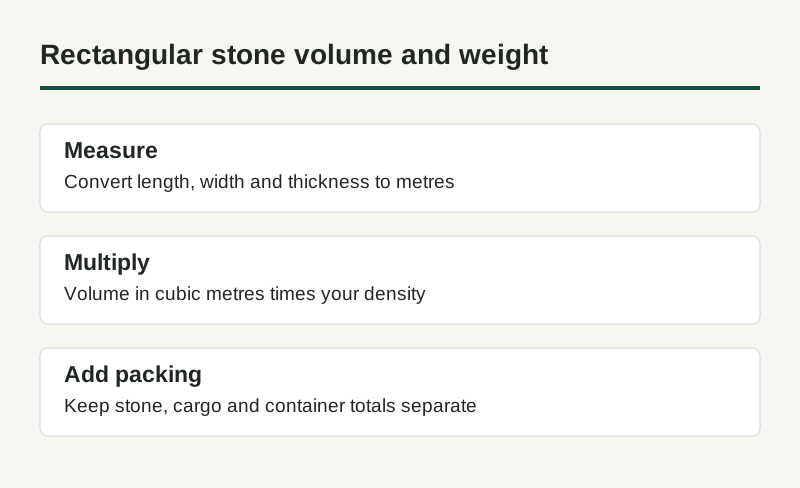
Read D as your evidenced density in kg/m³. The dimensions below are selected reference geometries, not standard supplied sizes or density claims. Multiplying the listed volume by D gives estimated kilograms per piece. Every dimension is the finished rectangular size; hollow, profiled or cut-out products need a different volume basis.
| Reference geometry | Dimensions used | Volume, m³ | Estimated piece mass, kg | Density status |
|---|---|---|---|---|
| 12 × 12 inch paver, 20 mm thick | 0.3048 × 0.3048 × 0.020 m | 0.0018580608 | 0.0018580608 × D | Enter your material evidence |
| 12 × 12 inch paver, 30 mm thick | 0.3048 × 0.3048 × 0.030 m | 0.0027870912 | 0.0027870912 × D | Enter your material evidence |
| 600 × 600 mm tile, 20 mm thick | 0.600 × 0.600 × 0.020 m | 0.0072 | 0.0072 × D | Enter your material evidence |
| 600 × 600 mm tile, 30 mm thick | 0.600 × 0.600 × 0.030 m | 0.0108 | 0.0108 × D | Enter your material evidence |
| Slab reference, 2 cm | 3.000 × 1.800 × 0.020 m | 0.108 | 0.108 × D | Slab dimensions are an example |
| Slab reference, 3 cm | 3.000 × 1.800 × 0.030 m | 0.162 | 0.162 × D | Slab dimensions are an example |
| Rectangular kerb reference | 1.000 × 0.150 × 0.300 m | 0.045 | 0.045 × D | Not a profiled-kerb calculation |
These are calculations from length × width × thickness; they are not weighed shipment records. The inch-to-metre conversion uses exactly 0.0254 m per inch, as documented in the NIST SI guide. Do not round dimensions before multiplying if you need to reproduce the table.
For G603, G654 and G682, lot-specific density remains Not established until a relevant report is supplied. No row substitutes a generic granite average. For a hollow kerb, edge profile, basin or slab with cut-outs, use the applicable net geometry or a measured mass rather than the full enclosing box. Reconcile the final packing list with actual packed dimensions and mass.
Worked example — invented numbers, not material data
These round numbers illustrate arithmetic only. They are not a density for G603, G654, G682 or any other supplied stone, and are not a container rating. They are not pre-filled in the calculator.
| Example input | Illustrative value |
|---|---|
| Length × width × thickness | 1,000 × 500 × 20 mm |
| Quantity | 10 pieces |
| Density | 2,500 kg/m³ — invented for this example |
| Packing, including supports and restraint materials | 30 kg — example allowance |
| Permitted cargo payload, excluding container tare | 1,000 kg — example limit |
The piece volume is 1 × 0.5 × 0.02 = 0.01 m³. Piece mass is 0.01 × 2,500 = 25 kg; ten pieces total 250 kg. With the example packing, estimated cargo mass is 280 kg, leaving 720 kg by weight against the example payload. The weight-only upper count is floor((1,000 − 30) ÷ 25) = 38 pieces with that fixed packing allowance. This does not show that those pieces physically fit or can be secured.
Density and the material record
Density starts empty. The G603, G654 and G682 records currently mark density as Not established for an offered lot, so none supplies a default here. Enter a value from evidence applicable to your material, and keep the report identity, method, date and units with your order. A catalogue average or colour match does not establish a batch result. See the density and weight guide for context.
What the payload comparison leaves to the loading plan
Enter a cargo allowance confirmed for your particular shipment with the carrier or forwarder. It excludes container tare and must respect the applicable equipment and route limits. Do not enter the maximum gross container mass as though it were available cargo payload. Include crates, racks, pallets, dunnage and securing materials in the packing allowance.
Rectangular volume treats the piece as a solid box. Cut-outs, profiled edges, irregular blocks, moisture and dimensional or density variation can change actual mass. No space packing, point loading, load distribution, floor capacity, lifting, bracing or restraint design is evaluated here. The IMO CTU guidance covers packing and securing questions that arithmetic cannot settle. This estimate is not a verified gross mass declaration or permission to load.
Use the container loading guide with the responsible loader and forwarder. Keep dimensions, quantity and packing requirements in the specification enquiry record, then link package labels and observations to the receiving inspection record.
Questions & discussion
Share a question or a useful experience about this guide. Comments appear immediately. Your name and comment are public. Email is optional and stays private; reply emails are not enabled yet. Comment privacy.