
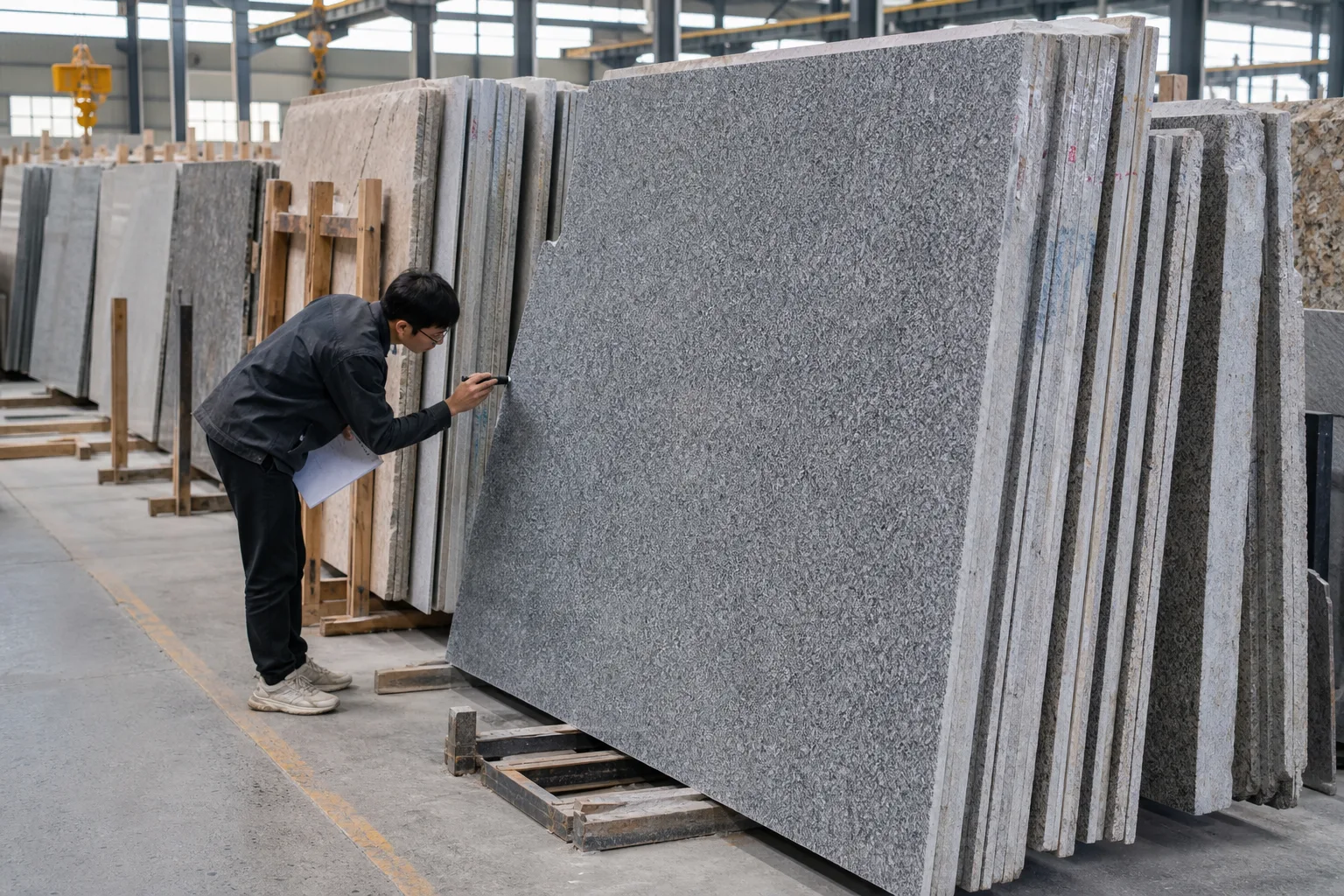
There is no single standard granite minimum order quantity in China. For an initial commercial inquiry, a practical expectation is that standard tiles and paving may be quoted from about 50 square metres or 100 pieces, while some slab or mixed project orders may require a bundle, crate or full 20-foot container. These are reference points rather than fixed industry rules: current marketplace listings show both a 50-square-metre minimum and a 100-piece minimum, with one listing also stating a full-container requirement in its detailed terms.[1][2][3] Buyers should therefore negotiate the MOQ only after fixing the material, dimensions, finish, quantity tolerances and packing plan.
Quick reference: how granite MOQs are quoted
An MOQ is the smallest quantity a seller is prepared to accept under a particular quotation. It is not necessarily the smallest quantity the factory can physically produce. The quoted threshold may reflect access to raw blocks or slabs, setup time, stock availability, crate efficiency, container loading, subcontracted finishing or the seller's commercial policy.
| Order type | Likely quote unit | Useful planning reference | Main point to confirm |
|---|---|---|---|
| Samples | Piece or sample set | Usually handled separately from production MOQ | Whether the sample represents the available production lot |
| Standard granite tiles | Pieces or square metres | Marketplace examples include 100 pieces and 50 m² | Whether dimensions, thickness and finish are standard stock |
| Cut-to-size panels | Square metres, pieces or project lot | Normally evaluated as one fabrication schedule | Number of unique sizes and permitted quantity overrun |
| Random or gangsaw slabs | Square metres, bundle or container | Stock slabs may allow a smaller lot than new production | Bundle integrity, slab dimensions and lot consistency |
| Pavers, kerbs and steps | Square metres, linear metres, pieces or container | MOQ depends strongly on section size and packing | Finish, dimensional tolerance, edge treatment and crate weight |
| Mixed products or colours | Crate or container | A combined shipment may reduce the total purchasing threshold | Minimum quantity for each individual material and specification |
The unit matters as much as the number. “100 pieces” could represent a small or substantial area depending on tile dimensions, while 50 square metres of thick steps creates a different production and freight requirement from 50 square metres of thin tiles. Ask the seller to convert the MOQ into pieces, net square metres, gross weight, crate count and estimated container utilization.
Why the minimum changes from one quotation to another
Geological identity and commercial trade name
Dimension stone is natural rock quarried as blocks or slabs and selected to meet requirements for size, shape, appearance and finish.[4] In geological usage, granite has a defined mineral composition. In the stone trade, however, “commercial granite” is a broader category that can include other hard crystalline igneous or metamorphic rocks.[5] A trade name or G-number should therefore be treated as a purchasing identifier, not as complete geological or provenance documentation.
Before discussing MOQ, request the exact commercial name, current slab or block photographs, country of extraction, processing location and an agreed reference sample. Do not assume that two suppliers using the same trade name have material from the same quarry, production lot or geological body. If origin is important to the project, make it a documented contract requirement.
Stock order versus new production
A seller may accept a small order when finished tiles or slabs are already in stock. New production may have a higher threshold because a block must be selected and sawn, machines must be set for the required thickness, and a finishing run must be scheduled. Ask whether the quotation is based on existing inventory, unfinished slabs, available blocks or material that has not yet been secured.
Repetition and fabrication complexity
One repeated tile size is generally easier to plan than an equal area divided among many panel sizes. Mitred edges, grooves, holes, sink cut-outs, curved pieces, sequentially numbered facade panels and tight visual matching can make a nominally small order operationally complex. The supplier may respond with a higher MOQ, a setup charge or a requirement to accept additional pieces produced for yield and breakage.
Match the MOQ to finish and application
Finishes
Polished, honed, leathered, flamed, bush-hammered, sandblasted, split and sawn finishes are not interchangeable descriptions. Polished granite has a reflective surface, honed stone has a lower-sheen appearance, and textured finishes alter the surface profile.[6] A factory may regularly run one finish but schedule another only in larger batches. Confirm the finish by an approved physical sample rather than by name alone.
For a small order, ask whether the finish is produced in-house, available from current stock or dependent on outside processing. This is a request for disclosure, not a reason to assume any particular supplier capability. Textured surfaces should also be reviewed for their effect on finished dimensions, cleaning, visual colour and application suitability.
Applications
The intended use should guide the specification before the buyer attempts to reduce the MOQ. Countertop slabs prioritize slab size, visual selection and fabrication yield. Flooring requires consistent calibration, dimensions and surface appearance. Exterior paving may require attention to strength, absorption, abrasion and freeze-thaw exposure. Facade panels introduce engineering, anchorage and project-specific performance considerations.
ASTM C615/C615M-23 covers material characteristics, physical requirements and sampling for granite dimension stone used in general building and structural applications. Its scope includes cladding, paving, landscape features, structural components and monuments, and it addresses properties such as absorption, density, compressive strength, modulus of rupture, abrasion resistance and flexural strength.[7] The applicable tests and acceptance limits must be selected for the actual project; a product description alone does not establish compliance.
Fix the specification before negotiating quantity
A low MOQ has limited value if the seller and buyer are pricing different products. Issue a written request for quotation with enough information to calculate material yield, production time and packing. At minimum, include:
- Commercial stone name and, where required, documented extraction origin.
- Approved reference sample, control slab or agreed colour range.
- Product type: slabs, tiles, pavers, kerbs, steps, countertops or cut-to-size panels.
- Finished length, width and thickness, including units of measurement.
- Dimensional, thickness, flatness and squareness tolerances.
- Face finish, back finish, edge profile and exposed-edge finish.
- Piece schedule, net quantity and permitted overrun or underrun.
- Requirements for repairs, resin, mesh, reinforcement, fillers and visible defects.
- Required test reports, test methods, report age and material-lot relevance.
- Inspection stage, sampling method and acceptance criteria.
- Crate construction, moisture protection, labels, packing list details and maximum crate weight.
- Incoterm, loading port, production basis and quotation validity.
The Natural Stone Institute advises that project requirements should be reviewed against the appropriate standards and that testing should be requested when suitable results are unavailable.[8] Do not accept a generic test report without checking the stone identity, quarry or lot relationship, specimen orientation, test method, test date and laboratory details. A laboratory report for a similarly named stone is not automatically evidence for the offered material.
Negotiation strategies that preserve quality
Ask for three quantity levels
Request prices and conditions at three levels: the seller's normal MOQ, a smaller trial quantity and a fuller production or container quantity. This reveals whether the constraint is manufacturing, packing, stock or commercial preference. Compare total order cost and landed cost rather than unit price alone.
Use existing production where appropriate
Ask whether your specification can be combined with an existing production run without changing the approved stone or quality requirements. A supplier may be able to use current block, slab or tile production, but the buyer should verify lot consistency and schedule. Never assume that “same colour” means the same material batch.
Reduce variation, not necessary controls
A smaller order becomes easier to quote when it uses one stone, one thickness, one finish and a limited number of repeated sizes. Simplifying edge profiles or accepting supplier-standard crate dimensions can also improve production efficiency. Do not trade away essential performance tests, tolerances or inspection rights solely to reach a lower MOQ.
Consider a paid trial order
A trial order can evaluate communication, document control, sample correlation, fabrication and packing before a larger commitment. It should still have a complete purchase specification and acceptance process. A trial shipment is not proof of long-term consistency, future capacity or quarry access.
Negotiate per material, not only per container
A seller may agree to load several products in one container while maintaining a separate minimum for each stone, thickness or finish. Ask for a loading plan showing the quantity, weight and crate count of every line item. Mixed loading can improve logistics, but excessive fragmentation may increase shade variation, packing complexity and replacement difficulty.
Pre-shipment inspection and packing checklist
Inspection should be tied to measurable requirements rather than broad labels such as “export quality” or “Grade A.” For further planning, see the guide to granite quality control and the reference on samples and mockups.
- Identity: compare production with the approved sample and confirm labels, material name and specified origin documentation.
- Quantity: reconcile finished pieces, net area, spares, crates and packing list totals.
- Dimensions: measure representative lengths, widths, thicknesses, diagonals and edge profiles using the agreed sampling plan.
- Appearance: review colour range, grain, veining, inclusions, repairs, chips, cracks and finish consistency under agreed viewing conditions.
- Fabrication: inspect holes, grooves, cut-outs, reinforcement, mesh, resin and panel numbering where applicable.
- Surface: compare polish or texture with the approved control sample and check for processing marks.
- Packing: verify separation, edge protection, bracing, crate identification and correspondence with the packing list.
- Documents: check the commercial invoice, packing list, bill of lading instructions, test reports and any contractually required certificates.
For shipments entering the United States, regulated solid-wood crates, pallets and dunnage must be appropriately treated and marked under applicable wood-packaging rules. U.S. Customs and Border Protection states that non-compliant wood packaging may be subject to immediate export.[9] Confirm current destination-country requirements with the importer or customs professional before shipment.
Price factors and the final buying decision
MOQ and price are connected, but the lowest threshold is not always the lowest-risk purchase. Material availability, block and slab yield, thickness, finish, edge work, number of sizes, tolerance, test requirements, inspection, packing, inland transport and container utilization can all affect the quotation. See the separate overview of granite price factors in China.
Compare quotations on a normalized schedule. Confirm whether quantities are net or gross, whether packing is included, which party bears inspection and testing costs, how replacements are handled, and which Incoterm applies. Conduct independent due diligence on the contracting company rather than relying only on a marketplace profile; the U.S. International Trade Administration notes that due diligence helps reduce partner, loss and liability risks.[10]
For most buyers, the sound approach is to establish the specification, request a sample, obtain quotations at several quantity levels and approve a documented inspection plan before placing the order. A stated MOQ is only a starting point. The commercially meaningful minimum is the smallest order that can meet the project's material, performance, consistency, packing and delivery requirements without relying on undocumented assumptions.
Frequently asked questions
What is a typical granite minimum order quantity in China?
There is no universal minimum. Illustrative marketplace listings include 50 square metres and 100 pieces, while some orders are offered only by bundle, crate or full container. The actual MOQ depends on the material, stock status, dimensions, finish, fabrication and packing.
Can I order less than one container of granite?
Sometimes. Stock slabs, standard tiles, samples or consolidated shipments may be available below a full container, but the minimum for each individual stone and specification must be confirmed. Freight efficiency and safe crate loading should also be evaluated.
How can a buyer negotiate a lower granite MOQ?
Request a paid trial order, use a standard thickness and finish, limit the number of sizes, ask about current stock or compatible production runs, and obtain quotations at several quantity levels. Keep essential specifications, testing and inspection requirements unchanged.
Does a low MOQ mean the granite will cost less?
Not necessarily. A smaller order may carry higher unit costs because setup, packing, inspection and freight are distributed across fewer pieces. Compare landed cost, specification compliance and replacement risk rather than MOQ or unit price alone.
Should the MOQ be agreed before approving a granite sample?
The buyer can request an indicative MOQ early, but the binding quantity and price should refer to a defined specification and approved sample. Otherwise, the buyer and seller may be discussing materially different products.
Questions & discussion
Share a question or a useful experience about this guide. Comments appear immediately. Your name and comment are public. Email is optional and stays private; reply emails are not enabled yet. Comment privacy.