
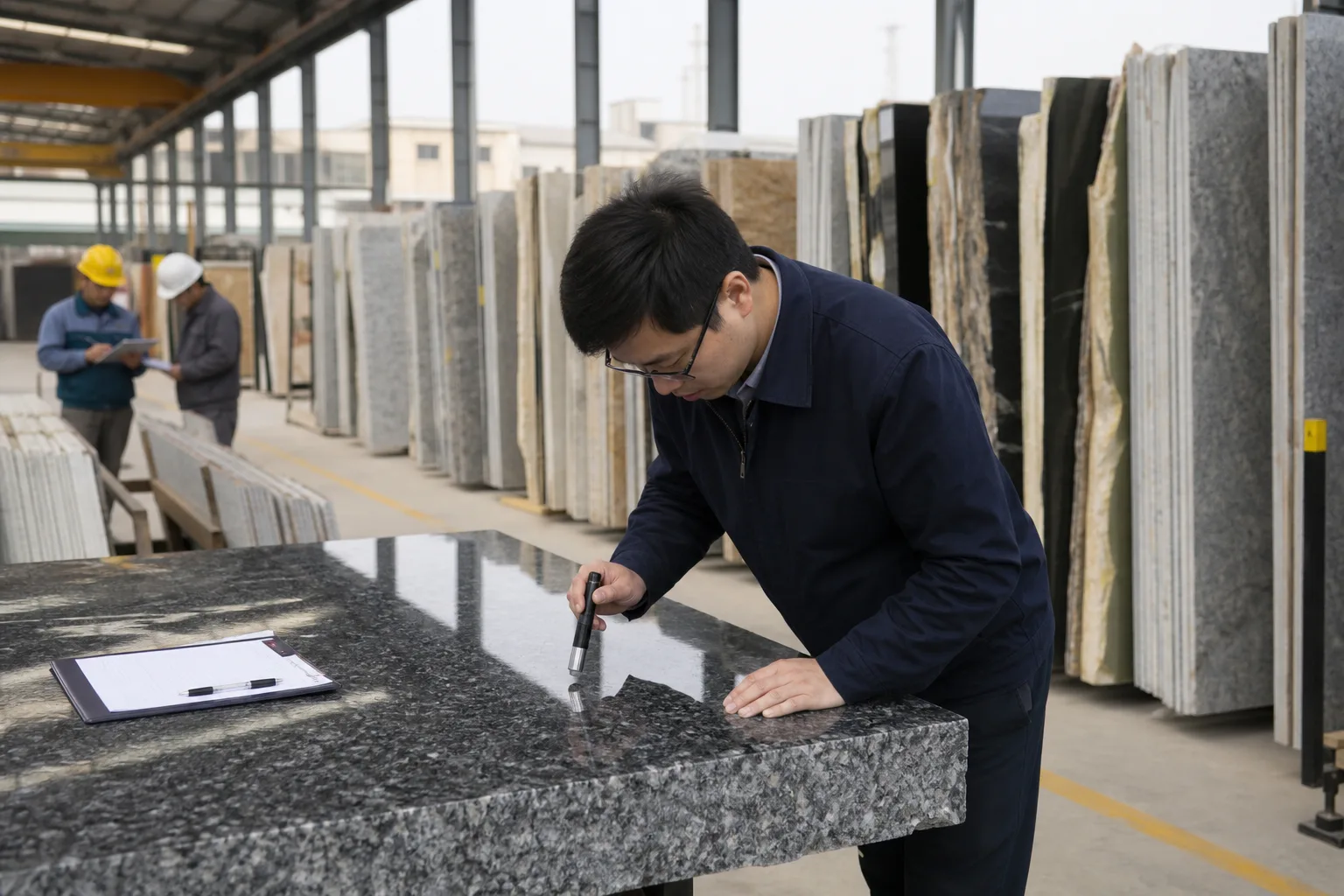
A granite supplier audit should establish four facts before an order is approved: who controls the transaction, where the stone comes from, which factory will process it, and whether that factory can reproduce the approved specification across the full shipment. Do not pass a supplier because its showroom, sample set or certificate appears credible. Pass it only when documents, production records, observed processes and traceable material agree. Use the checklist below for quarry-linked factories, independent fabricators and trading companies, adjusting the depth to the application and order risk.
Define the audit scope before visiting
A supplier audit is not the same as a final inspection. The audit evaluates the organization, supply chain and controls that are expected to produce conforming stone. A pre-shipment inspection checks a particular lot after production. Buyers normally need both when color range, finish, dimensional tolerance or installation performance is important.
Confirm the contracting entity
Record the legal company name in Chinese and English, registration details, registered address, bank beneficiary and invoicing entity. Compare these details with the quotation, sales contract, factory signage and export documents. A mismatch does not automatically prove misconduct, but it requires a documented explanation before payment.
Determine whether the supplier is a quarry operator, factory, trading company or a combination. A trading company may be suitable if it identifies the actual processor and maintains effective controls. A factory may also outsource finishing, edge work or packing. The audit should therefore map every organization that can change the stone or its identification. See the separate guide to factories and trading companies.
Set evidence requirements
- Issue the product specification and audit agenda before the visit.
- Request permission to inspect production, raw-material storage, laboratories and packing areas.
- Ask for recent records for comparable products, with customer information redacted if necessary.
- Require original or independently verifiable documents rather than screenshots alone.
- List any outsourced processes and arrange access to critical subcontractors.
The U.S. Commercial Service treats partner investigation as continuing due diligence rather than a one-time search. It also offers company background services in China, which may supplement but not replace a stone-specific technical audit. Review the U.S. Commercial Service China guidance.
Separate geological identity from trade names
Dimension stone is natural rock quarried as blocks or slabs to specified size and shape. Color, pattern, texture, finish, strength and durability can all affect selection, according to the U.S. Geological Survey. See the USGS dimension stone definition. A commercial name, code or translated name does not by itself establish geological identity, quarry source or performance.
Audit the material reference
Place the supplier’s quotation, approved sample, current slabs and raw blocks together where possible. Record all names and codes used for the material. Ask whether the quoted stone is domestic Chinese material, imported block processed in China, or stock bought through another distributor. Do not describe imported stone as Chinese granite merely because fabrication occurs in China.
For variable materials, approve a representative range rather than one small piece. A useful control set can include a signed sample, calibrated photographs, slab layout or mock-up, and written limits for background color, grain, veins, mineral concentrations, repaired areas and other natural features. The buyer and supplier should use the same acceptance vocabulary. Further procedures are covered in samples and mock-ups.
ASTM C1721 distinguishes commercial and geological classification in petrographic examination. Petrography can identify mineralogy, texture and composition relevant to intended performance, but a report applies to the tested specimen; it does not prove that every later shipment comes from the same deposit. Review the ASTM C1721 scope.
Verify quarry and block-supply controls
Quarry ownership is not essential, but source control is. If the supplier claims to own or exclusively control a quarry, verify the claim through site access and supporting documents rather than repeating it in purchasing or marketing records. If blocks come from third parties, inspect the supplier’s incoming identification and segregation process.
Evidence to examine
- Quarry name and location stated at the level the supplier can substantiate.
- Block purchase, transfer or extraction records linked to block numbers.
- Photographs or site observations showing current extraction faces and natural variation.
- Block tags that remain traceable through slab cutting and finished-product packing.
- Rules for separating similar-looking stones, quarry benches, lots and customer orders.
- Contingency plans for exhausted faces, seasonal interruption or rejected blocks.
Compare current blocks with the approved range, but do not infer long-term consistency from a single quarry face. Geological variation may occur within one deposit. For repeat programs, define how the supplier will notify the buyer when production moves to another bench, source or commercially equivalent material.
Audit factory processes and finish control
Walk through the production route in material-flow order: block receiving, sawing, drying, resin or repair where applicable, calibration, finishing, cutting, edge work, drilling, cleaning, inspection and packing. Record which steps are performed on site. Equipment lists are less useful than evidence that operators control the process and detect nonconforming work.
Dimensions, tolerances and workmanship
Ask operators to demonstrate the instruments used for length, width, thickness, diagonal, flatness, edge geometry, hole position and finish. Check calibration status or verification records where measurement affects acceptance. The contract should state tolerances and measurement methods; terms such as “standard tolerance” or “export quality” are not measurable requirements.
Review how the factory handles chipped edges, cracks, filled pits, resin, mesh backing, color enhancers and other treatments. The audit should not assume that a treatment is always acceptable or always defective. Require disclosure and acceptance rules suitable for the product and application.
Finish and application
Polished, honed and leathered surfaces differ in gloss and texture, while flamed, bush-hammered, sandblasted, sawn and split finishes are commonly considered for other architectural uses. Marble.com provides a commercial overview of granite finishes. Audit each ordered finish separately because machinery, feed rates, abrasives, brushing and operator judgment can change appearance and texture.
- For polished granite, define acceptable gloss consistency, polish lines and edge-to-face match.
- For bush-hammered surfaces, approve texture density and allowable edge margins.
- For flooring, stairs, patios and exterior paving, assess the finish against project-specific abrasion, slip, drainage and maintenance requirements.
- For facades, review panel dimensions, anchor preparation, orientation, repairs and engineering requirements.
Check specifications, testing and the quality system
ASTM C615/C615M covers material characteristics, physical requirements and sampling for granite dimension stone used for general building and structural purposes. Relevant tests may include absorption and bulk specific gravity, compressive strength, modulus of rupture, abrasion resistance and flexural strength. The required combination depends on the application. The Natural Stone Institute advises obtaining testing when performance data are unavailable rather than assuming suitability from the stone category alone. See its dimension-stone standards summary.
Validate test reports
- Match the report’s material name, quarry or sample identification to the offered stone.
- Check the laboratory, test method, specimen condition, units and report date.
- Confirm that sampling represents the source and orientation relevant to the order.
- Do not substitute a test report for a visually similar trade name.
- Refer structural and application-specific interpretation to the project designer or qualified stone specialist.
ASTM C1799/C1799M explains that specimen selection and preparation affect dimension-stone testing and that test data should help predict performance in a specific application. Review the ASTM sampling guide.
Quality-management evidence
As of September 20, 2026, ISO lists ISO 9001:2026 as the current edition of its quality-management requirements. Certification is voluntary and does not replace product verification. If a supplier claims certification, check the exact company name, site address, scope, standard edition, issuing body and validity. Then test whether documented procedures operate on the factory floor. See ISO’s description of ISO 9001:2026.
ISO 19011:2026 describes evidence-based and risk-based principles for management-system auditing. Apply that approach by sampling records and tracing real orders instead of reviewing procedures in isolation. See the ISO 19011:2026 overview.
Granite supplier audit checklist
| Audit area | Evidence to sample | Verification action | Serious warning sign |
|---|---|---|---|
| Company identity | Registration, contract, invoice and bank details | Match names, addresses and transaction roles | Unexplained payment to an unrelated entity |
| Material identity | Approved sample, blocks, slabs and product labels | Trace one material code through production | Trade name changes between quotation and packing |
| Quarry or block source | Block tags, purchase records and source declarations | Reconcile selected blocks with finished lots | Source cannot be identified or keeps changing |
| Factory capability | Machines, operators and comparable work records | Observe production of the ordered process where possible | Critical operations are hidden or undisclosed |
| Finish control | Master sample, process settings and inspection records | Compare pieces under consistent light | No approved range or measurable finish criteria |
| Dimensional control | Drawings, tolerances, instruments and results | Repeat measurements on sampled pieces | Operators use different methods or unverified tools |
| Testing | Laboratory reports and specimen identification | Match reports to source and intended application | Generic report for an untraceable material |
| Nonconforming product | Quarantine area, defect records and corrective actions | Follow one rejected item to disposition | Rejected material can return to packing unnoticed |
| Packing and loading | Packing specification, labels and loading records | Check moisture protection, restraint and package identity | Packages cannot be linked to the packing list |
| Social and import traceability | Supplier declarations and upstream production records | Map entities involved in mining and processing | Supplier refuses to identify upstream parties |
Classify findings as critical, major or minor using criteria agreed before the audit. A critical finding may justify stopping approval or shipment. Major findings normally require evidence of corrective action before production or payment advances. Minor findings can be tracked with deadlines when they do not compromise the order.
Price factors and China sourcing decisions
An audit should explain the quotation, not negotiate toward an unsupported target. Compare material source, block yield, slab or tile size, thickness, finish, edge work, tolerances, selection range, repairs, testing, packing, order quantity and subcontracting. A lower price may reflect a broader color range, smaller usable dimensions, alternative packing or fewer inspection steps rather than greater efficiency. Use the same specification when comparing offers and review China granite price factors and minimum order quantities.
Marketplace listings can identify possible suppliers and product terminology, but they do not verify stock, quarry rights, factory ownership or current capability. StoneContact, for example, displays a broad directory of granite tiles and slabs offered by China-based suppliers. Treat such listings as leads for investigation, not audit evidence. View the mapped supplier directory.
For shipments to the United States, importers should also review country-of-origin marking and supply-chain obligations with their customs adviser. CBP states that importers must use reasonable care and provide documentation sufficient to determine admissibility; it also advises importers to understand where and how products are manufactured or produced. Review CBP’s forced-labor compliance guidance. This audit checklist is a commercial and technical framework, not a customs or legal determination.
Issue a written audit report that identifies the audited legal entity, sites, processes, products, evidence sampled, unavailable areas, findings, corrective actions and approval limits. Link supplier approval to a defined stone, factory and process. Any later change in quarry source, processor, finish route, treatment or packing method should trigger documented review and, when risk warrants, a new audit or enhanced granite quality-control plan.
Frequently asked questions
What is the difference between a granite supplier audit and a shipment inspection?
A supplier audit evaluates the company, source controls, factory processes, quality system and ability to produce consistently. A shipment inspection samples a specific production lot to determine whether it meets the purchase specification. One does not replace the other.
Must a China granite supplier own a quarry?
No. A factory or trading company can source suitable blocks from independent quarries. The audit should instead verify source disclosure, block identification, incoming inspection, lot segregation and notification procedures when the source changes.
Does ISO 9001 certification prove that granite will meet the specification?
No. Certification concerns a quality-management system and does not certify a particular stone, finish or shipment. Verify the certificate and its scope, then examine production records, test evidence, traceability and finished material against the order requirements.
Which granite test reports should a buyer request?
The required tests depend on the application and project specification. They may address absorption, density, compressive strength, modulus of rupture, flexural strength or abrasion resistance. Reports must be traceable to the offered source and based on representative specimens.
Can an online supplier listing replace a factory audit?
No. A listing may help identify candidates and commercial stone names, but it does not establish quarry rights, legal identity, available stock, factory ownership, process control or current export capability.
Questions & discussion
Share a question or a useful experience about this guide. Comments appear immediately. Your name and comment are public. Email is optional and stays private; reply emails are not enabled yet. Comment privacy.