
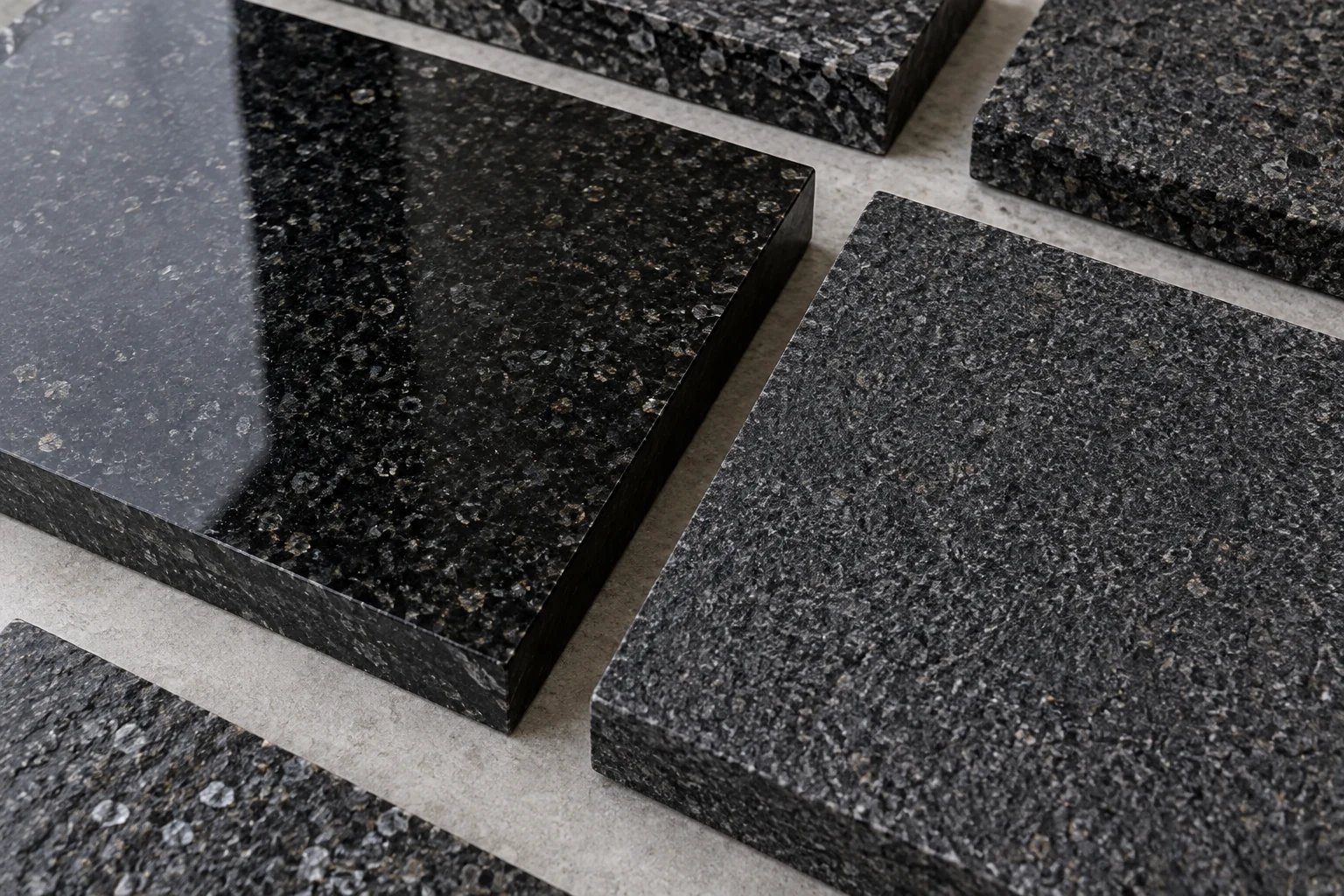
Selecting a deep-black field
Choose black granite by the darkness and mineral pattern of the finished face, then decide how closely neighbouring pieces must match. A nearly continuous black field and a charcoal surface with fine light flecks are different visual targets. For a restrained scheme, define the permitted pale grains, patches and tonal spread explicitly; do not assume black stone naturally varies less than a lighter family.
Build Value Stone lists Shanxi Black / G777 as an absolute-black Chinese stone, with polished, honed and flamed options. Its listing anchors a trade example, not a universal appearance standard. View several dry pieces in the intended light, including the proposed edge finish, before choosing the depth of black. Use the light versus dark countertop guide for room-level selection.
Shanxi Black / G777: connect the name to the order
“Black granite” is a commercial colour grouping. The Natural Stone Institute distinguishes commercial categories from scientific rock names, so darkness does not identify the geology or source. Keep the seller’s precise name, extraction declaration, processing location and lot reference with the approved sample set.
| Named example | What it establishes for selection |
|---|---|
| Shanxi Black / G777 — Build Value Stone | A seller’s black-stone offering in slabs, tiles and countertop forms, with several finish options |
| Shanxi Black monuments — SRS Stone | A seller’s memorial offering with shaped, carved and polished work; matching the name alone does not establish matching material |
Approve actual production-range samples using the samples and mock-ups guide. Keep that reference tied to the order through receipt. Numerical properties must come from the offered lot’s own identifiable test reports, with the method and date; this colour record supplies no family-wide values.
Separate natural darkness from colour treatment
A dark, even face is not proof of untreated material. Tenax describes Toner Black as an enhancer for homogenising black granite colour, and its two-component black-granite system uses a black epoxy treatment for toning and coverage. These manufacturer examples show why appearance alone cannot settle the question; they do not establish that any Shanxi Black lot has been treated.
Ask the processor to state whether dye, pigment, colour enhancer, resin or coating has been used, identify each product and provide its technical and care information. Request treatment records tied to the slabs and, where available, paired references before and after the declared process. Treat an “untreated” statement as a claim requiring traceable support. If treatment status remains unresolved, leave it unresolved in the purchase record rather than interpreting an evenly black photograph as verification.
Countertops and memorials ask different questions
For a countertop, review whole slabs with the fabricator: the dark field across seams, visible mineral concentrations near cut-outs, and the relationship between the face and profiled edge. Record the slab layout before cutting. A small polished sample cannot show where a conspicuous pale patch will fall on the finished work; support and cut-out design remain the fabricator’s responsibility.
For memorial work, the SRS listing includes shaping, carving and polishing. Review the intended lettering or carving against the selected face, and the colour relationship between upright, base and adjoining pieces. Agree these details with the maker; the responsible installer and relevant authority must settle foundation, fixing and permitted design. A countertop approval does not answer those memorial questions.
Receive and care for the specified black finish
At receipt, compare piece references, darkness, pale mineral features and face-to-edge finish against the retained samples and layout. Record unexpected patches, repairs or finish differences before installing disputed pieces. Keep any declared treatment attached to the care handover, especially if future refinishing or replacement is planned.
The Natural Stone Institute’s care guidance starts with identifying the stone and the problem. A pale mark on a black face is not itself a diagnosis. Use the stain-removal guide and the actual treatment manufacturer’s instructions rather than selecting a chemical from the colour alone.
Questions & discussion
Share a question or a useful experience about this guide. Comments appear immediately. Your name and comment are public. Email is optional and stays private; reply emails are not enabled yet. Comment privacy.