
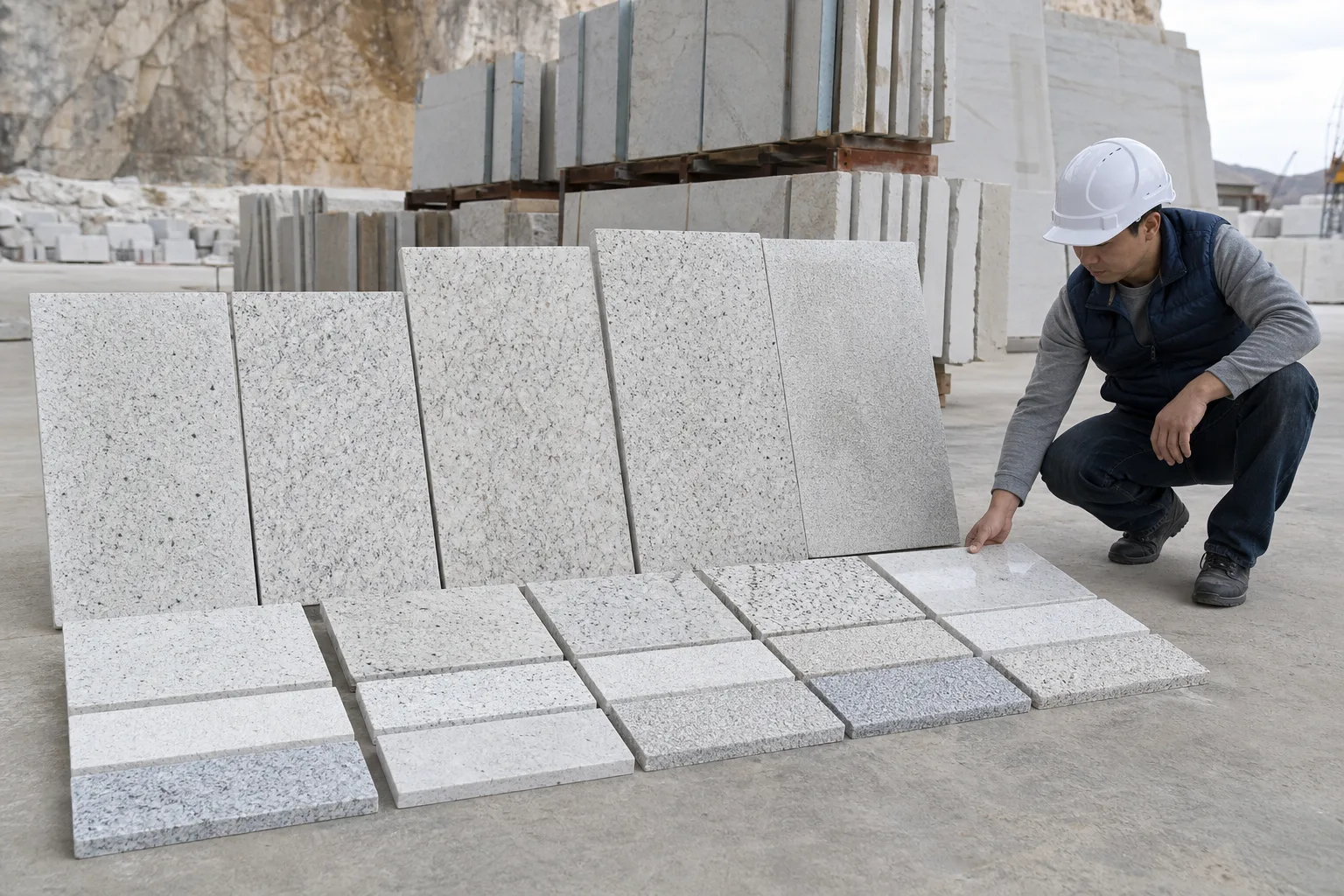
White Chinese granite is best treated as a sourcing category, not a single stone. The term usually covers pale gray, silver-white or off-white crystalline stones sold under quarry codes, regional names and translated trade names. Their grain, black mineral content, background tone and performance can differ. For commercial investigation, select the appearance from current samples, then specify the finish, dimensions, permitted variation, test requirements and inspection method before comparing quotations.
What “white Chinese granite” means
Commercial identity versus geological identity
In stone commerce, “granite” is broader than the strict geological definition. The Natural Stone Institute explains that the commercial granite group can include several igneous and metamorphic rocks that behave similarly in fabrication and use. The U.S. Geological Survey likewise defines dimension stone by its production as blocks or slabs meeting requirements for size and shape, with color, grain, pattern and finish forming part of the specification. A color label alone therefore does not establish mineral composition or engineering performance. Natural Stone Institute: scientific and commercial definitions; USGS: dimension stone information.
“White” is also a relative commercial description. Many stones in this category appear light gray because dark mineral grains are distributed through a pale background. A polished surface may make those grains and tonal differences more visible, while a textured finish can produce a flatter or lighter-looking surface. Procurement documents should use an approved physical sample or mockup rather than relying on the word “white,” a screen image or a supplier’s catalog category.
Trade names are identifiers, not complete specifications
Chinese granite may be offered under an alphanumeric code, an English color name, a transliterated regional name or several aliases. G603, for example, appears in the market under names including Sesame White and Bianco Crystal, while some listings classify it as gray rather than white. This illustrates why a trade name should identify a sample set, not substitute for one. StoneContact records these multiple names but does not, by itself, verify that material from different sellers or production periods is identical. StoneContact: New G603 Granite trade names.
- Record the supplier’s exact stone name and code.
- Ask whether the offered material comes from the same block source as the samples.
- Assign a date and reference number to every approved sample.
- Do not approve a replacement quarry, substitute stone or “equivalent” color without a new review.
Varieties and appearance selection
Use appearance groups before relying on names
A practical comparison begins with visual structure. Fine-grained stones tend to read as a more continuous gray-white field from a distance. Medium or coarse grains create stronger speckling. Some selections contain evenly distributed black minerals; others show clusters, pale patches, darker bands or directional movement. None of these features is automatically a defect unless the purchase specification excludes it.
Compare candidates under consistent lighting and at the viewing distance expected in the completed work. A countertop sample should show the polished face and intended edge. A paving sample should use the proposed textured finish. For a façade or large floor, a multi-piece mockup is more useful than a single hand sample because it exposes joint contrast and piece-to-piece variation.
Define an acceptable range
Natural stone cannot be controlled as a uniform manufactured color. The useful objective is a documented range. Retain a light-limit sample, a dark-limit sample and representative samples of acceptable grain density. Add written rules for features that matter to the project, such as concentrated dark patches, rust-colored minerals, veins, open fissures, repaired areas or directional banding. The limits should be realistic for the selected production lot and agreed before cutting begins.
For more detail on setting visual tolerances, see color variation in natural stone and the guide to common granite defects.
Finish options and their effects
The finish changes color, reflectance, texture, cleaning behavior and suitability for foot traffic. Marble.com distinguishes polished, honed and leathered countertop finishes and also identifies flamed, bush-hammered, sandblasted, tumbled and sawn treatments. Finish names are not precise enough for approval on their own; abrasive sequence, machinery and production settings can produce visibly different results. Marble.com: granite finishes.
| Finish | Typical visual result | Common applications | Approval focus |
|---|---|---|---|
| Polished | Glossy face with stronger color and grain contrast | Countertops, wall panels and interior flooring | Gloss consistency, reflection, scratches and edge match |
| Honed | Smooth, low-reflectance surface with a softer tone | Interior floors, walls and selected work surfaces | Uniformity, handling marks and response to staining |
| Flamed | Rough, non-glossy texture that can lighten the apparent color | Exterior paving, patios and steps | Texture consistency, loose grains, edge condition and thickness |
| Bush-hammered | Regularly pitted, coarse face | Steps, paving, landscape units and façade accents | Tool pattern, depth, cleanability and edge definition |
| Split-face | Irregular natural-looking relief | Walling, cladding accents and landscaping | Relief range, usable thickness and installation plane |
| Sawn | Visible cutting pattern with limited refinement | Utility work or an intermediate production surface | Saw marks, flatness and whether further finishing is required |
Slip resistance cannot be inferred safely from a generic finish label. Where pedestrian safety is material, specify the required test method and acceptance criterion for the actual stone, finish and service condition. Countertop buyers should also approve the face and edge finish together because an edge may appear darker or glossier than the adjoining surface.
Applications and material selection
Interior work
Light granite can support kitchen countertops, vanity tops, wall linings, stairs and flooring. Countertop orders require slab review for layout, cutouts, edge profiles and seams. Flooring orders need controls for thickness, calibration, squareness, shade distribution and the relationship between surface texture and maintenance. Large areas should be dry-laid or sorted according to an agreed placement plan when visible variation is important.
Exterior and landscape work
Potential uses include patios, driveways, stairs, kerbs, wall caps, façades and landscape elements. Suitability must be established for the particular stone and assembly. Exterior selection can require evidence addressing water absorption, strength, abrasion, anchorage, environmental exposure and the intended load. A stone’s classification as granite or its successful use in another climate is not a project-specific performance report.
Façade panels require an engineered attachment design and dimensional controls appropriate to the anchoring system. Vehicle paving requires suitable unit thickness, base design and edge support. Stair treads require coordinated tread dimensions, finish coverage and edge details. These decisions should be made by the responsible project professionals rather than inferred from a catalog photograph.
Specifications and test documentation
ASTM C615/C615M covers granite dimension stone for general building and structural purposes. Its scope includes material characteristics, physical requirements and sampling, with properties addressing absorption, density, compressive strength, modulus of rupture, abrasion resistance and flexural strength. The applicable standard, edition, test orientation, laboratory and acceptance limits must be stated in the contract; merely writing “ASTM granite” is incomplete. ASTM C615/C615M-23.
Information to put in an inquiry or purchase specification
- Stone trade name, supplier code and approved sample references.
- Product type: slab, tile, panel, tread, paver, kerb or cut-to-size component.
- Finished length, width and thickness with tolerances.
- Face finish, edge finish, exposed edges and permitted arris condition.
- Hole, slot, groove, cutout, reinforcement and anchoring details where applicable.
- Acceptable color and grain range, plus rules for mixing lots.
- Limits for cracks, chips, repairs, stains, mineral concentrations and surface marks.
- Required test methods, current reports and project acceptance values.
- Piece marking, packing, crate identification and packing-list format.
- Inspection stage, sampling level and remedy for rejected goods.
A laboratory report should identify the tested stone clearly enough to connect it to the offered material. Check the trade name, sample identification, source declared by the supplier, test dates, methods, units and individual results. Do not assume that a report for a similarly named stone, an earlier quarry source or another supplier’s stock represents the order.
Inspection before shipment
Practical inspection checklist
- Confirm identity: compare production pieces with the signed reference samples and purchase order.
- Review the lot: inspect pieces across multiple crates or bundles, not only selected display pieces.
- Measure dimensions: check length, width, thickness, diagonal difference, flatness and edge geometry using the agreed tolerances.
- Check finish: view pieces in consistent light for gloss, texture, tool marks, scratches, burn marks or uneven processing.
- Record natural features and defects: separate acceptable variation from excluded cracks, chips, stains, repairs or concentrated markings.
- Verify fabrication: check cutouts, holes, grooves, profiles and reinforcement against approved drawings.
- Review packing: confirm dry, stable crates, separation between finished faces, correct labels and a traceable packing list.
- Document findings: issue measurements and photographs tied to crate and piece numbers, with clear pass, repair or reject status.
The inspection plan should distinguish cosmetic checks from laboratory testing. A visual inspector cannot confirm flexural strength or absorption by looking at the stone. Conversely, a compliant laboratory result does not prove that finished pieces meet color, dimension, finish or packing requirements. See granite quality control and third-party inspection.
Price factors and sourcing from China
White Chinese granite prices cannot be compared reliably without aligning the specification and delivery basis. Cost varies with available block or slab sizes, selection strictness, finished thickness, format, finish, edge work, cutouts, reinforcement, order quantity, packing and production yield. Inland transport, port charges, freight, insurance, inspection, duties and the chosen Incoterm also affect landed cost. A lower unit quotation may exclude services or tolerances included elsewhere.
Ask each bidder to quote the same bill of quantities and state exclusions. Clarify the minimum order quantity, sample charges, payment milestones, packing method, loading quantity and validity period. Separate product cost from optional testing, inspection, molds, templates and special packing. Current freight, customs classification and import charges should be confirmed for the destination and shipment date rather than copied from an earlier transaction.
Supplier and production verification
A Chinese stone exporter may be a quarry operator, processor, trading company or a combination of these roles. None should be assumed from a website description. Verify the contracting entity, business address, production location, control of raw material, subcontracted processes and responsibility for claims. The U.S. International Trade Administration recommends detailed investigation of prospective foreign representatives, including status, history, principals, references and ability to meet special requirements. International Trade Administration: evaluate foreign representatives.
For an order requiring tight shade control, establish how blocks or slabs will be reserved and how replacement pieces will be matched. For fabricated work, approve shop drawings before cutting. For mixed products, confirm whether all items will be produced at one facility. A supplier audit can verify the declared production route, while inspection should remain tied to the actual order. Further planning resources include importing granite from China, evaluating Chinese granite suppliers, factory versus trading company, container loading and shipping cost factors.
Frequently asked questions
Is white Chinese granite actually white?
Many stones sold in this category are pale gray, silver-white or off-white with visible black mineral grains. Approve the color from current finished samples and define an acceptable range instead of relying on the word “white.”
Is G603 the only white Chinese granite?
No. G603 is a widely encountered trade code within the light gray and white commercial category, but the category includes other named materials and look-alike selections. Even G603 listings can use several aliases, so the code does not replace sample approval.
Which finish should be specified for white granite paving?
Flamed and bush-hammered finishes are common candidates for exterior paving because they create textured surfaces. The decision should be based on a finished sample, the required slip-resistance test, cleaning expectations, climate, unit thickness and pavement design.
What should be checked before ordering granite from China?
Confirm the contracting company, production location, stone identity, approved sample range, dimensions, finish, test documentation, defect limits, packing, Incoterm and inspection plan. Verify any claimed quarry ownership, factory capability or certification independently.
Questions & discussion
Share a question or a useful experience about this guide. Comments appear immediately. Your name and comment are public. Email is optional and stays private; reply emails are not enabled yet. Comment privacy.