
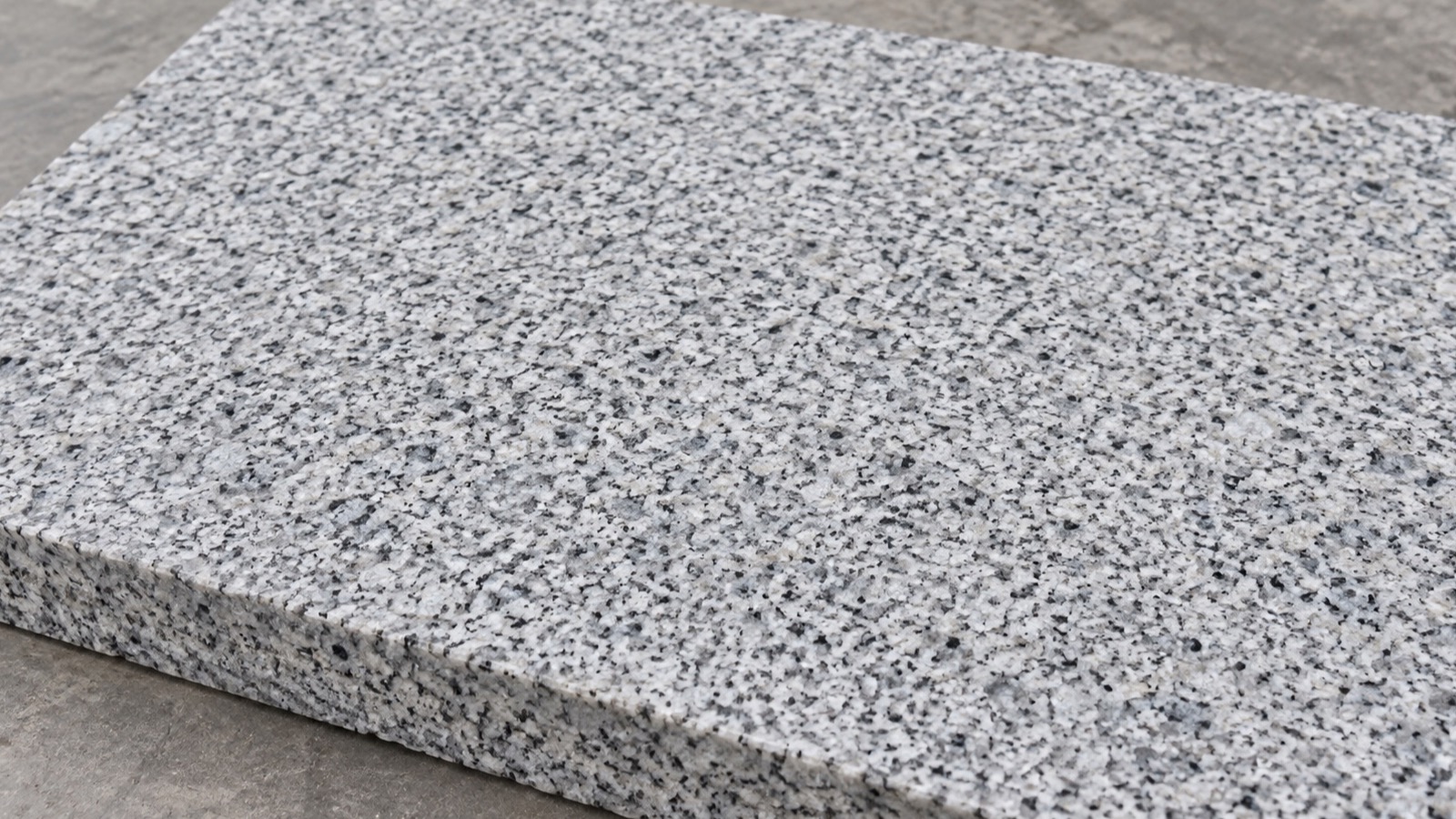
G603 is widely used as a commercial label for light-grey or sesame-grey Chinese granite supplied as slabs, tiles, paving and fabricated pieces. The label is useful for initial searching, but it is not a globally controlled geological designation. Listings under G603 refer to different locations and replacement materials, so a buyer should approve a current production sample and record the declared source rather than assuming every G603 order is interchangeable.
Identity and naming
Commercial listings describe G603 as grey granite from China and show names such as sesame white, China grey and regional variants. One StoneContact material entry identifies a Dalian G603 from Liaoning; other market listings attach the number to Hubei or Fujian-associated supply. This inconsistency is the central sourcing issue. The purchase record should state the seller’s exact material name, quarry province or location, processing factory, sample reference and batch.
If continuity matters, ask whether the offered stone is original production, a replacement source or simply a visually similar material. Keep those answers with photographs of slab faces and backs. A G-number should help organize records, not replace traceability.
Appearance and variation
The common visual expectation is a light-to-medium grey ground with a small, relatively even black-and-white crystalline pattern. Grain scale, warmth, dark spotting and the balance between light and dark minerals vary. Polishing makes contrast and reflections more apparent; thermal or mechanically textured finishes can lighten the face and reduce visible contrast.
Agree on the permitted range using several representative pieces. Define how concentrated dark minerals, rusty marks, veins, edge chipping, open fissures and repairs will be handled. A tiny sample may hide banding or clusters that become obvious across paving or a facade.
Finishes and fabrication
Commercial G603 offerings commonly include polished, sawn, sanded, sandblasted, tumbled and rough-faced work. Availability on a marketplace does not prove that every source reacts identically to each process. Ask for finish samples made from the offered batch. Compare color, texture depth, arris condition and cleaning behavior.
For repeated modular pieces, confirm calibration and squareness. For steps, kerbs and thick paving, check visible edges as well as faces. For polished slabs, inspect reflected light for uneven gloss, resin concentration, mesh backing, pits and repairs. Resin or reinforcement is not automatically unacceptable, but it should be declared and compatible with fabrication and service conditions.
Suitable applications
G603-type grey granite is marketed for interior and exterior floors, wall work, counters, monuments, fountains, coping and landscape pieces. Suitability still depends on the specific source, finish, thickness, exposure and assembly. Textured surfaces may be considered for exterior pedestrian areas, while polished surfaces are often selected for interior decorative work. An engineer or designer should determine structural dimensions, anchorage and movement accommodation.
Performance evidence to request
Ask for recent reports that identify the material and test method. Depending on the project, the schedule may include absorption, density, compressive strength, modulus of rupture or flexural strength, abrasion resistance and freeze-thaw evaluation. ASTM C615/C615M covers physical requirements and sampling for granite dimension stone, but contract documents should state the applicable edition and acceptance criteria.
Do not transfer results from one G603 supplier or quarry to another merely because the number matches. Report dates, sample identifiers and laboratory details should connect the evidence to the offered production.
Turn the selection into a measurable specification
A trade name, photograph or sample is a starting point, not a complete order. Record the approved material name, quarry or block reference when available, surface finish, nominal and minimum thickness, face dimensions, edge work, dimensional tolerances, visual range, repair policy, quantity, spare allowance, packing and labeling. State which measurements will be checked, how many pieces form the inspection sample and what happens when a result falls outside the agreed limit.
Natural stone varies. A sensible approval defines an acceptable range rather than asking production to match one small photograph. Review multiple full-size samples or a dry layout when appearance continuity matters. Keep the signed sample and dated photographs available to the factory and destination inspector. For performance-sensitive work, ask for recent reports from representative material and identify the test method; a generic claim that granite is “strong” does not establish suitability for a particular assembly.
| Control | Record before production | Verify before shipment |
|---|---|---|
| Identity | Trade name, source and approved range | Labels and production match approvals |
| Geometry | Dimensions, thickness and tolerances | Measurements across a defined sample |
| Finish | Process, sheen or texture reference | Consistency under normal lighting |
| Fabrication | Edges, cut-outs, repairs and reinforcement | Workmanship and critical locations |
| Packing | Crate design, sequence and marks | Dry stone, protection and count |
Buying and approval checklist
- Ask the seller to distinguish quarry origin, processing location and shipment origin.
- Approve representative samples and retain a signed control sample.
- Put measurable tolerances and visual criteria on the purchase order.
- Confirm test methods and report dates for performance claims that affect the project.
- Inspect a first piece before full production and a defined sample before shipment.
- Match packing, crate marks and piece labels to the installation sequence.
- Keep a reasonable spare allowance for natural variation, cutting and future repair.
These controls do not remove variation or project risk. They create a record that lets the buyer, fabricator, installer and inspector evaluate the same requirements. Local building codes, engineering requirements and installation-system instructions remain controlling for the finished work.
Frequently asked questions
What should buyers verify before ordering G603 Granite?
Verify the exact material and source, current representative samples, finish, dimensions and tolerances, relevant test evidence, repairs, packing, inspection plan and complete commercial terms.
Does a trade name or country guarantee performance?
No. Natural stone properties and factory controls vary. Evaluate the actual material, batch, finish, thickness and installation conditions with project-specific evidence.
How should natural variation be approved?
Review multiple representative pieces or full slabs, define an acceptable range, retain signed samples and record how veins, mineral clusters, fissures, fills and repairs will be judged.