
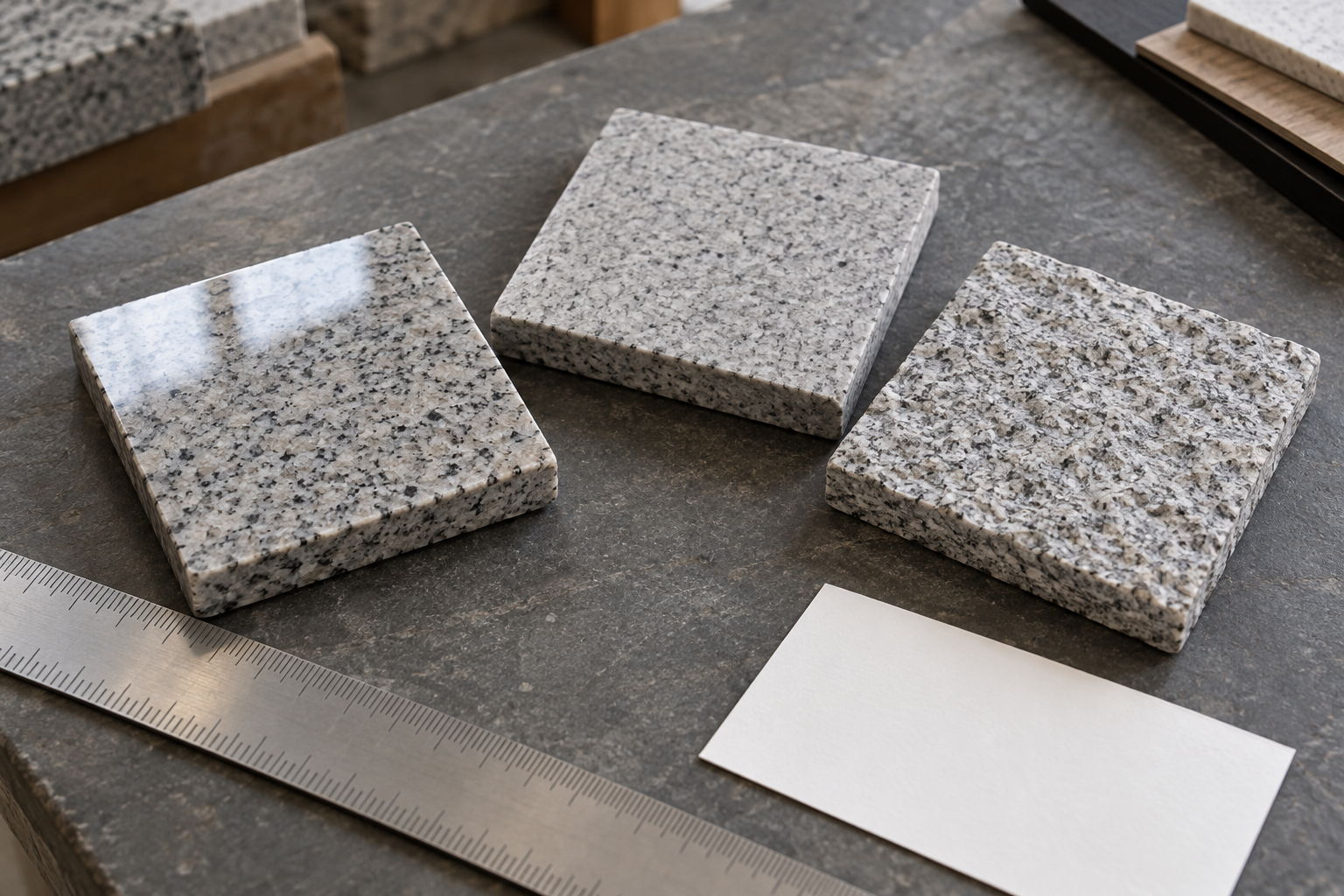
Treat G655 as a commercial name to verify, not a guarantee of one quarry, appearance or performance. A seller uses Hazel White and Tongan White for its G655 offer and declares a Fujian source. Establish the actual material, finish and lot before approving it; numerical properties without a traceable report remain Not established.
Commercial & trade names
G655 is used as a commercial stone code. Tingida markets Hazel White Granite with G655 and Tongan White names. Keep the complete offered name and the seller’s legal identity in the order record; an alias does not establish equivalence between different lots. Commercial granite classification is not an independent petrographic identification.
Colours & expected variation
Start with the light ground and visible mineral pattern in representative physical samples. Approve the actual range rather than a selected catalogue square. Keep the finish, lighting, moisture condition and sample IDs consistent. A code does not establish a fixed color tolerance, grain size or freedom from visible variation.
Quarry & region context
Tingida’s public Hazel White description declares Tong’an, Fujian, China. That is a seller’s origin statement, not independent verification of the quarry for an offered order. The precise quarry, extraction rights, block source and lot linkage remain Not established here. Request the declared quarry and processing addresses separately; fabrication or export through China does not prove quarry origin.
Available finishes
The same seller advertises polished, honed, flamed, bush-hammered and sandblasted options. Confirm current availability for the actual material. Compare finish samples for appearance, texture and maintenance needs; a rough finish name does not establish a project slip result. Use the finish references to frame the enquiry.
Available formats
The listing offers slabs, tiles and fabricated pieces, but its catalogue sizes are not universal G655 standards. Obtain the actual available slab dimensions, usable area, thickness and fabrication drawing. Keep tolerances in the purchase specification, following sizes and tolerances, rather than deriving them from the trade name.
Typical applications
The seller describes interior and exterior uses, including countertops, flooring and facades. Those are marketed applications, not approval for a particular assembly. For patios or stairs, assess finish, drainage, loading and exposure. For facades, use project-specific engineering and anchorage assessment. Request test evidence relevant to the offered stone and proposed geometry.
Technical data to request
| Property | Value for the offered stone | Evidence & date |
|---|---|---|
| Density / bulk specific gravity | Not established | No traceable laboratory report for an identified offered lot was established. Catalogue ranges are not adopted as batch results. |
| Water absorption | Not established | No lot-linked report, specimen condition and applicable method established. |
| Compressive strength | Not established | No representative report identifying specimen source and test condition established. |
| Flexural strength / modulus of rupture | Not established | No evidence established for the proposed material, thickness and orientation. |
| Abrasion resistance | Not established | No relevant test result established for the intended flooring or paving. |
| Slip resistance | Not established | No result established for the actual finish, treatment and use condition. |
| Freeze–thaw performance | Not established | No exposure-specific evidence established for the offered lot. |
| Dimensions, thickness & tolerances | Not established | Define these on the purchase drawing; no universal values follow from G655. |
Inspection points
Match the retained sample, specification revision and packing list before comparing the production pieces.
- Check ground tone and mineral variation across the actual range, not just one polished face.
- Record cracks, fills, resin, mesh and visible repairs separately from transport damage.
- Measure critical dimensions, thickness and fabrication against the drawing with the agreed sampling method.
- Photograph piece and crate IDs so close-ups can be traced to the received shipment.
- Record exceptions and their disposition; do not silently substitute another stone under the same code.
Use the receiving inspection record and samples and mockups guidance to retain that linkage.
Related comparisons
A similar light-grey photograph does not make G603 or another code an equivalent replacement. Compare the retained samples and separately establish origin, test properties and availability. If the design changes, document it as a new material decision. Do not transfer a laboratory result from another code, quarry or earlier order.
Related sourcing guides
Send each candidate the same finish, format, sample range, drawing and packing requirements. Compare quotations on the same delivery terms and record exclusions. This page supplies no current price or supplier ranking.
Before using the weight calculator, obtain a density value applicable to the actual material; the G655 name supplies no default. Keep supplier checks separate from material approval.
Public ASTM scopes identify the kinds of properties to request; they are not laboratory reports for G655 and do not certify a shipment.
Frequently asked questions
Is Hazel White always the same stone as any offer called G655?
No equivalence is established for an unidentified order. Confirm the seller's full name, declared source, retained samples and lot evidence.
What density should I enter for G655?
Use a value supported by evidence for the offered material. No default density is established by this record.
Questions & discussion
Share a question or a useful experience about this guide. Comments appear immediately. Your name and comment are public. Email is optional and stays private; reply emails are not enabled yet. Comment privacy.