
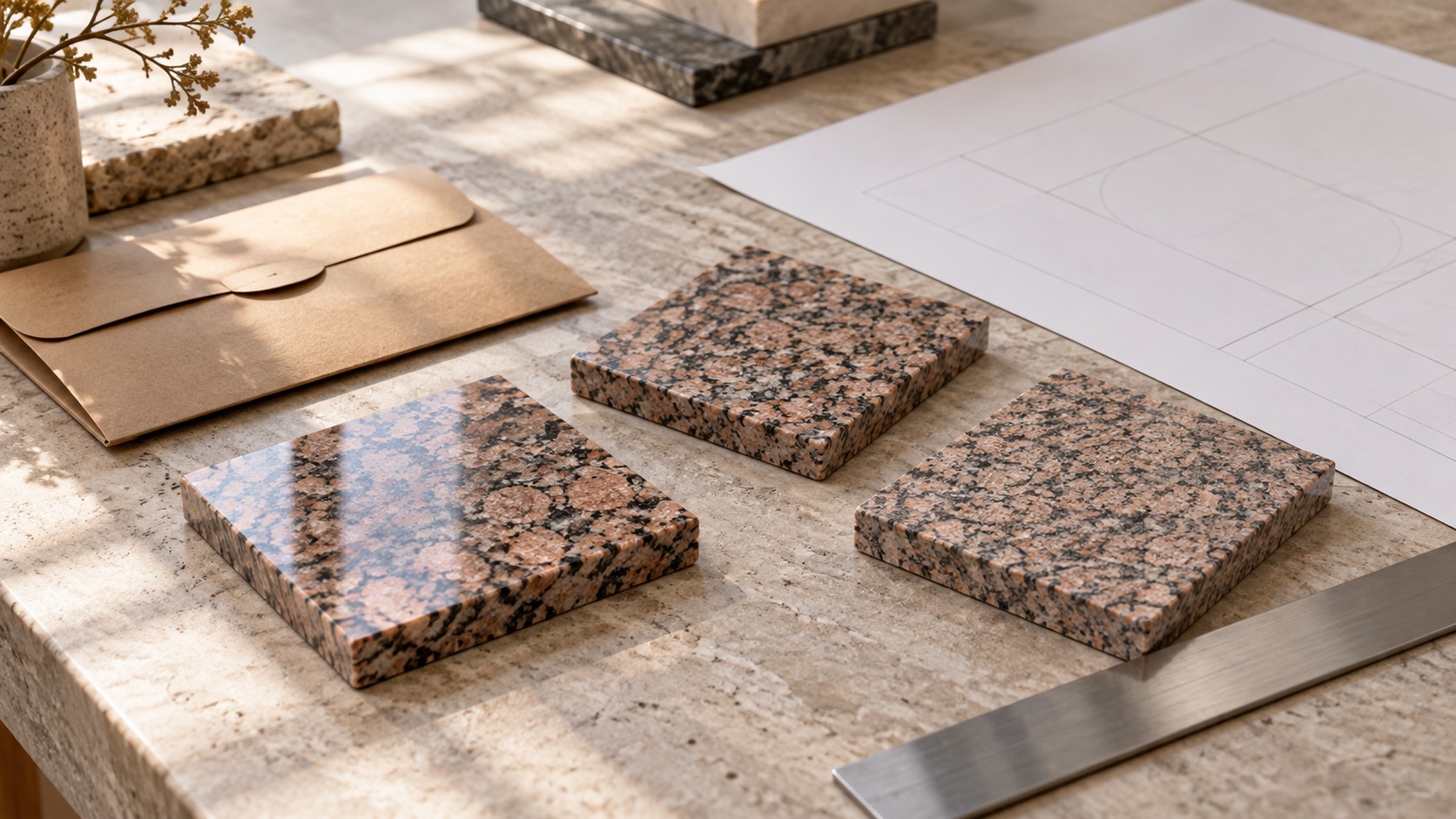
G664 is commonly marketed as a pink-brown Chinese granite under names including Bainbrook Brown. Use the trade name to locate the offer, then check the actual colour range, finish and project evidence before ordering. Granite China is an independent buyer reference; this record helps you specify and inspect a purchase.
Commercial & trade names
G664 is a commercial granite designation used in Chinese stone catalogues. Jiamei Stone lists Bainbrook Brown, Misty Brown and Luoyuan Red alongside G664; PANMIN’s DeyuanStone listing also pairs G664 with Bainbrook Brown. These are direct seller descriptions, accessed October 26, 2026, rather than an independent identification of your order.
Put the exact offered name and supplier reference on the order. If geological identity matters to the design, request identification evidence for the offered material. An alternate English name is useful for searching, but it cannot settle whether two offers refer to the same source or selection.
Colours & expected variation
Expect a pink-brown or brown overall impression with lighter and darker mineral grains, rather than a single paint-like colour. The cited catalogues use different colour descriptions: Jiamei calls its entry brown, while PANMIN lists white and brown tones. Judge the actual offered range in the intended finish instead of requiring every shipment to match one web image.
Natural variation can occur within an order. Ask for pieces representing the proposed range, labelled to show which blocks or production lots they came from. Review them together under agreed lighting, with dry faces, then record any additional wet-condition review needed for outdoor work. Agree which features are normal variation and which require a separate decision.
Stone Federation’s sample-panel guidance, accessed October 26, 2026, explains why selection should represent variation across the relevant stone bed and blocks. A larger layout helps reveal a distribution of tones that a single small chip cannot show.
Quarry & region context
Jiamei’s G664 entry describes a Luoyuan, Fujian origin. Treat that as the supplier’s description of its catalogue material, not as proof of the extraction source for a future order. Ask the seller to declare the source that will fulfil your purchase and connect the submitted samples to it. Keep quarry location, processing location and shipping port in separate fields.
Available finishes
Polished, honed, flamed and bush-hammered options appear in Jiamei’s G664 catalogue; PANMIN also lists polished, honed and flamed finishes. Availability must be confirmed for the offered material and production run. Sources accessed October 26, 2026.
| Finish to discuss | What to compare on the sample | Decision to settle |
|---|---|---|
| Polished | Reflections, visible mineral pattern and consistency across edges | Does the sheen suit the setting, and what does the finished surface need for care? |
| Honed | The proposed matte appearance and visible marks under grazing light | Is the appearance acceptable after normal cleaning? |
| Flamed | Texture distribution, local smooth patches and colour change after processing | Is there relevant evidence for the intended walking surface? |
| Bush-hammered | Tool pattern, edges and consistency between pieces | Can the required texture and cleaning routine be maintained? |
A rough-looking surface is not a slip guarantee. Specify assessment for the actual finish and intended wet or dry use. The Natural Stone Institute’s standards guidance, accessed October 26, 2026, ties test selection to the application; flooring and vertical stone do not need identical evidence. The UK Slip Resistance Group provides specialist guidance on reliable floor testing and interpretation.
Use the finish library for general methods and the flamed-versus-honed comparison for that separate choice. Retain a finish-control sample for this G664 order. Ask about proposed treatments, sealers and cleaning requirements before accepting the finish.
Typical applications
Supplier catalogues advertise G664 in countertops, flooring, wall work and exterior paving. That establishes offered uses, not approval for every assembly.
| Intended use | What to resolve before ordering |
|---|---|
| Countertops and vanity tops | Fabricator-approved support, seams, cut-outs, edge treatment and cleaning requirements |
| Interior flooring and stairs | Intended traffic, surface condition, cleaning and slip assessment |
| Wall panels | Panel dimensions, thickness, fixing design and substrate suitability |
| Exterior paving and steps | Local exposure, drainage, expected loading, finish, bedding and applicable testing |
Do not choose paving thickness from the G664 name or assume a polished slab is appropriate for a wet walking area. Have the responsible designer or installer establish project requirements. In freezing climates, request relevant exposure evidence; for a facade, obtain the fixing and structural design appropriate to that assembly. Browse the product formats before turning the material choice into a drawing.
Inspection points
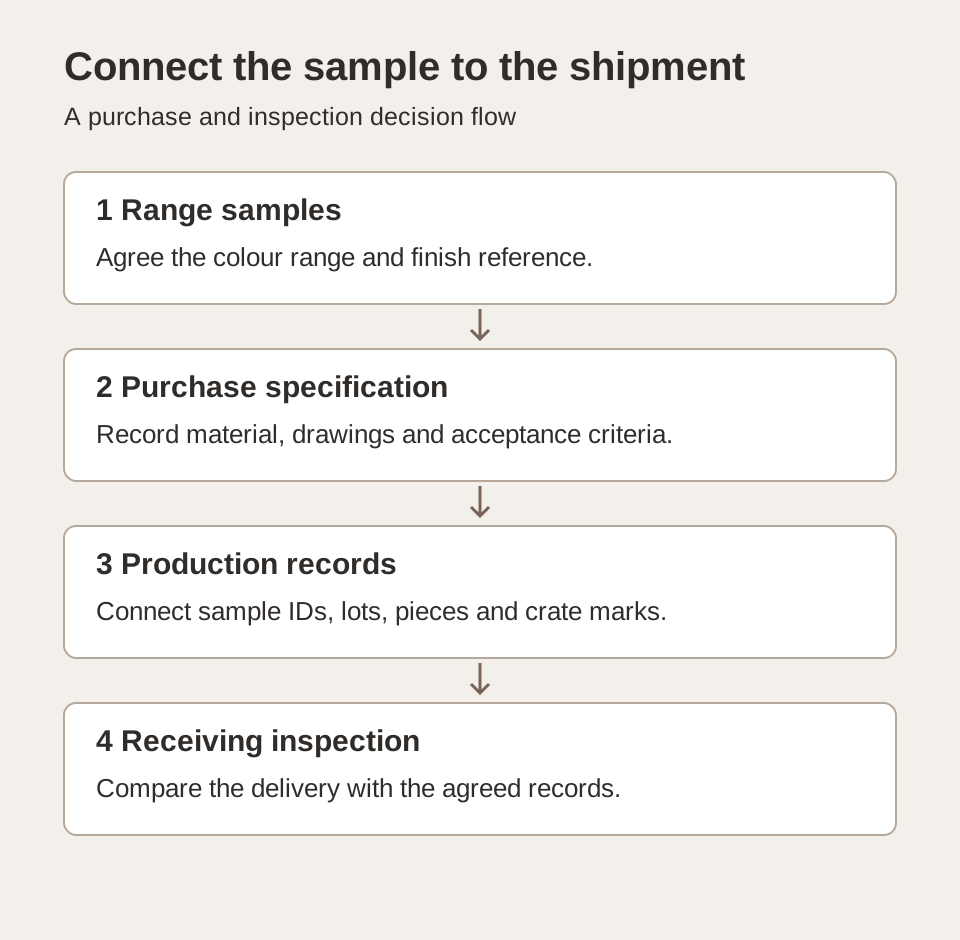
Use this flowchart to keep a material decision connected to the order and the delivered pieces.
- Approve a range. Request representative samples from the proposed supply, including the finish and any visible edge treatment. Record identifiers and agreed viewing conditions. For colour-sensitive work, approve a representative layout.
- Write the specification. Record the offered trade name, source declaration, format, dimensions, thickness, tolerances, finish, edge profile and piece schedule. State how natural features, repairs and substitutions will be handled. Use the specification builder to organise those fields.
- Connect production to approval. Ask for production-lot references, piece or crate numbering, and records showing which material was selected. Agree sampling and acceptance criteria with the supplier before cutting and packing.
- Check receipt against the record. Photograph crate labels and overall condition before unpacking. Compare delivered pieces with the retained range and finish controls; check dimensions and visible damage against the agreed inspection plan. Link close-ups to identifiable pieces and preserve original files in the receiving inspection record.
Separate what you observed from the decision to accept it. If the delivered colour distribution, finish or identity differs from the agreed record, identify the affected pieces and resolve the difference with the responsible party.
Related comparisons
Bainbrook Brown and Misty Brown may be presented as alternate names for G664. Do not assume differently named offers are either identical or different solely from their labels. Compare supplier declarations, representative samples and relevant test records.
The site’s G603, G654 and G682 entries are separate material records for a broader shortlist. Do not substitute one for G664 by copying its property figures or its approval sample. Where appearance cannot identify the offered stone reliably, settle identity through samples and appropriate testing.
Related sourcing guides
Keep the approved range, finish reference, drawing revision and receiving criteria together. A catalogue name starts the discussion; the signed specification and traceable samples define what the order is meant to contain. Continue through the sourcing and inspection hub and the stone library for the next records to prepare.
Questions & discussion
Share a question or a useful experience about this guide. Comments appear immediately. Your name and comment are public. Email is optional and stays private; reply emails are not enabled yet. Comment privacy.