
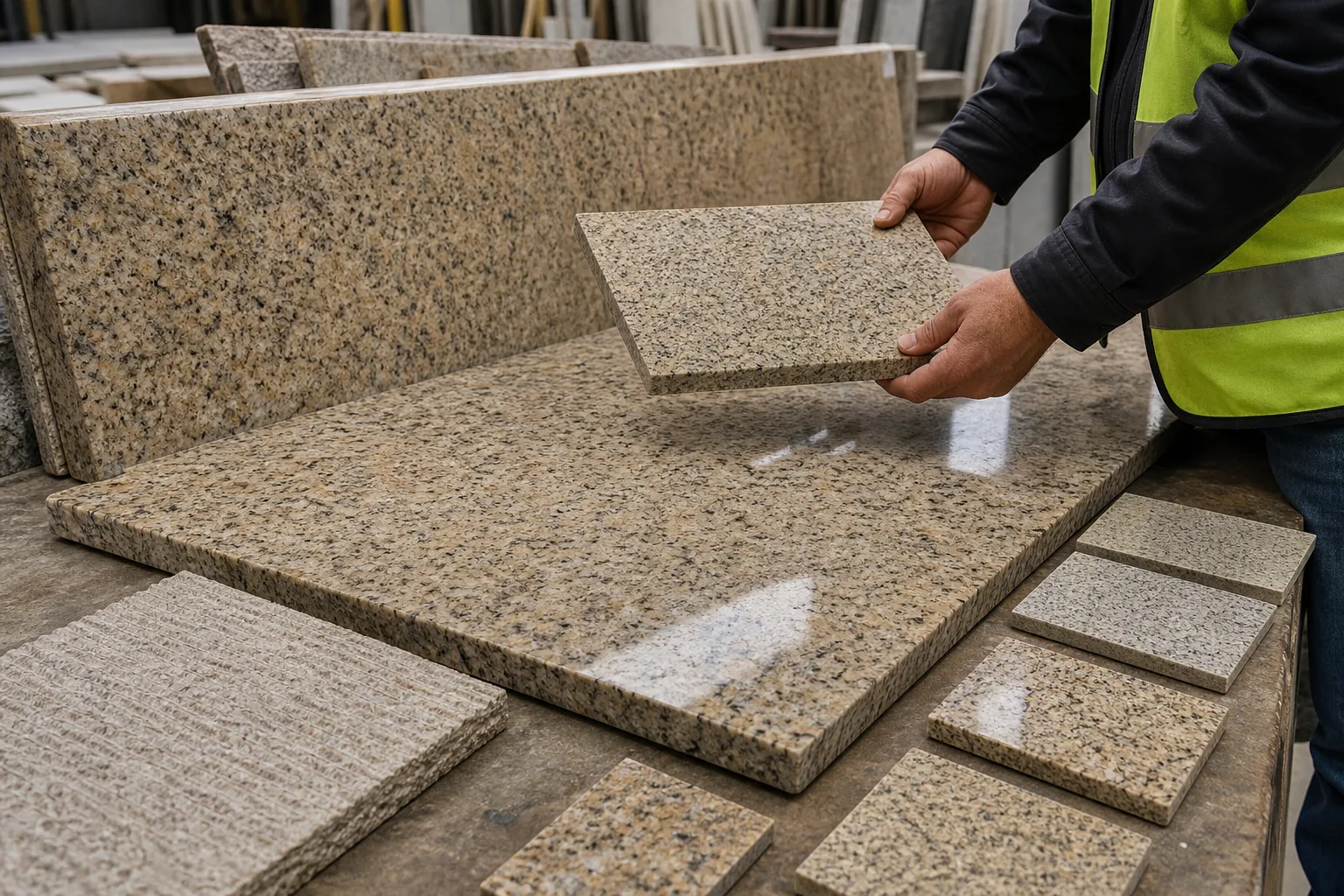
G682 is a commercial material label. Use it to find the offered stone, then approve its real colour range, finish and specification with traceable records. This page has no retained same-lot samples or laboratory reports; the property table therefore leaves unestablished values explicit instead of borrowing figures from unrelated catalogue entries.
Commercial & trade names
Record G682 exactly as offered, with every alternate name and source declaration. Pizrog lists Padang Giallo G682 with names including Padang Gelb and Golden Sand. These describe its own catalogue entry. They do not establish that every seller’s G682 is the same stone.
If geological identity matters, request the relevant identification evidence. Keep the offered commercial label, any petrographic description and the purchaser’s approved reference in separate fields so none is mistaken for proof of the others.
Colours & expected variation
Some seller listings describe yellow, gold or rustic tones. Do not turn those descriptions into a universal G682 appearance rule. Approve actual dry pieces showing the proposed light-to-dark range, mineral concentrations and tonal variation, then define what distribution is acceptable in the installation.
Record lighting, finish, moisture condition, sample IDs and dated images. Stains, oxidized-looking areas, repairs and naturally occurring minerals need observation and an agreed disposition; a catalogue colour name cannot decide whether a feature is acceptable.
Quarry & region context
Quarry source for an offered order: Not established here. The label is not enough to assign a Fujian origin. For example, Yongfeng’s own G682 listing declares a Shandong/Wenshang product. This is evidence of that supplier’s claim, not independent proof of the source of any future shipment.
Keep quarry, processing and export locations distinct. Ask which source will fulfil the order and whether the retained samples came from that source. Use the Quarries & regions group to frame the questions without treating regional background as lot traceability.
Available finishes
Yongfeng advertises flamed, polished, brushed and other finishes for its own listing. Confirm what the actual supplier can produce on the offered lot, then compare finish samples side by side. Surface processing can change the visual impression and the visibility of individual features.
Read the Finishes group. For the order, retain a physical finish sample and record acceptable workmanship on both faces and visible edges. A description such as “rough” does not replace a finish reference or a slip assessment.
Available formats
Specify whether the order is slabs, tiles, paving, stairs, kerbs, wall work or fabricated pieces. The form changes what must be measured, how pieces are supported during transport and which edges require protection.
Use the slab guide and sizes and tolerances to assemble drawings. Put thickness, edge profiles, holes, repair permissions and piece-numbering requirements on the purchase record. There is no universal G682 dimensional tolerance established by this page.
Typical applications
Discuss flooring, patios, stairs and landscaping as separate applications, with their own support, exposure and maintenance questions. A listed use is a reason to investigate, not an approval for a particular load or wet condition.
For visible colour-controlled work, review an area layout before accepting the range. For exterior work, assess drainage, weather exposure and appropriate test evidence. The purchaser’s designer or other responsible professional must settle assembly-specific requirements.
Technical data to request
| Property | Value for the offered stone | Evidence & date |
|---|---|---|
| Density / bulk specific gravity | Not established | No dated, traceable report for an identified offered lot was available. Do not use a generic granite density as a measured value. |
| Water absorption by weight | Not established | No lot-linked absorption report was available. A water-drop screen does not establish laboratory absorption. |
| Compressive strength | Not established | No report identifying specimens, method and condition was available. |
| Flexural strength / modulus of rupture | Not established | No applicable report for the offered stone, thickness and orientation was available. |
| Abrasion resistance | Not established | No traceable test report for the proposed flooring or paving material was available. |
| Slip resistance | Not established | Must be evaluated for the actual finish, treatment and intended wet or dry use; no project result was supplied. |
| Freeze–thaw performance | Not established | No representative exposure-specific test or service evidence was supplied. |
| Dimensions, thickness & tolerances | Not established | These are project purchase requirements, not fixed properties of a trade name. Agree them on drawings and verify production pieces. |
Inspection points
Start with the approved range, the purchase specification and the packing list together. Check identifiers before comparing colour: a plausible appearance does not establish that the inspected material belongs to the approved lot.
- Compare faces and visible edges in the agreed finish, lighting and moisture condition. Record concentrated minerals, fissures, fills, mesh or resin treatments separately from handling damage.
- Measure dimensions, thickness, squareness and critical fabrication details against the drawing; use the agreed sampling plan rather than an invented universal tolerance.
- Photograph crate exteriors and labels before unpacking, then photograph piece IDs, overall condition and edge damage with a scale. Keep original files and link every close-up to an identifiable piece.
- Separate observations from acceptance decisions. Record what is outside the agreed range, who can decide its disposition and which pieces remain on hold.
Use the Inspection & receiving guides, edge-chip acceptance guide and receiving inspection and claim record guidance. The edge-chip decision file helps keep damage evidence and the purchaser’s decision together. None of these references certifies an unexamined shipment.
Related comparisons
Compare G603 and G654 using separate physical range samples and separate evidence schedules. A similar product form does not make them equivalent; a different colour family may also change the designer’s expectations for distribution and visible marking.
The Guides & Comparisons hub provides wider selection references. No claim of cheaper pricing, improved durability or guaranteed stain resistance follows from the G682 label.
Related sourcing guides
Work through Samples & approval before agreeing the production run. Retain the approved pieces and record the viewing conditions in the sample and mockup instructions.
Then record the sizes and tolerances, packing and loading arrangements and inspection scope in the order. Crate marks, layout references and spare pieces should connect the production documents to the receiving inspection.
Compare quotations against the same selection range, finish, fabrication, packing and terms. This page provides no live price, supplier endorsement, completed inspection or laboratory result. The cited public standard scopes explain the kind of evidence to request; their full paid clauses have not been reviewed for this record.
Frequently asked questions
Does G682 have one universal density or water-absorption value?
No value is established here for an unidentified offered lot. Ask for a dated report that identifies the material, specimens and test method, and check its relevance to the order.
Can a catalogue picture approve the colour range?
No. Keep representative physical samples or lot-linked evidence in the intended finish, under agreed lighting and moisture conditions. An illustrative image is not approval evidence.
Questions & discussion
Share a question or a useful experience about this guide. Comments appear immediately. Your name and comment are public. Email is optional and stays private; reply emails are not enabled yet. Comment privacy.